Reference edition
The History of the Linux Desktop
Before the smartphone, AI and Google, I needed a way to create an e-commerce platform. Microsoft's servers gave me no flexibility to do that. I knew those servers well: I had taken and passed Microsoft's certification exams and worked as a Microsoft Certified Product Specialist. They took what they needed from other systems like BSD to dial the Internet and get their desktop to support a browser. I had to find an operating system and platform to run web services, create simple catalogs and take payments. UNIX systems could do that but I could not afford the least expensive of those brands.
A friend told me about a little known operating system developed by MIT and a Finnish student named Linus Torvalds. I could afford Linux.
I loaded Linux on a discarded Digital Equipment 486 and it ran better
than I expected. I found a Red Hat CD Rom but later changed to Caldera
because it had an Internet browser. I did not know the commands. After
finding posts people made in mailing lists, I found ways to execute
commands, compile source code and get Linux working as an Internet
server.
Early in my experiment with Linux, I learned everything except how to connect to the Internet. As I searched the Internet I noticed an absence of a call center or a help desk anywhere. After learning enough Linux to set up a web site, I used it to start a Linux support line people could call.
I felt surprised at the many calls I received and my lack of familiarity with the services people needed. I learned Linux, used my networking skills and eventually recruited some programmers that knew Linux and put them to work. We built a UNIX clone of Outlook and started making money.
I wrote a couple of books for O'Reilly Media on using the Java Desktop System and then Linux System Administration. I succeeded in learning to administer Linux in a large organization, built software and became IBM's first Linux Influencer Partner. I did that before anyone developed a certification program.
The want ad
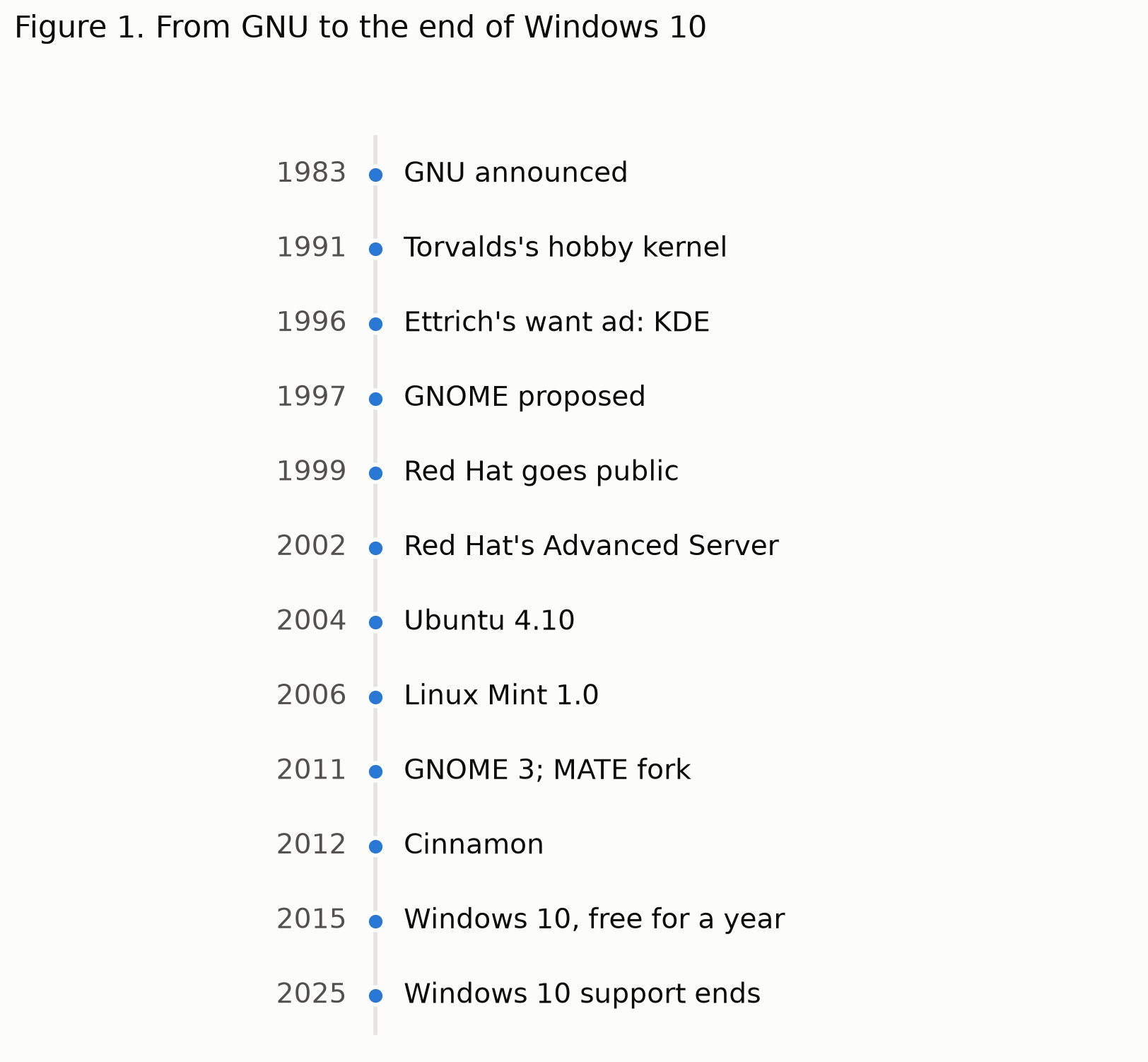
On October 14, 1996, a graduate student in Tübingen, a university town in southern Germany, posted a request for help.2.1 Matthias Ettrich put it on Usenet, the public discussion boards of the early Internet, where anyone could write to a group named for its subject and strangers in other countries answered.
Ettrich used Linux, and he liked where it was going. "Unix popularity grows thanks to the free variants, mostly Linux," he wrote.2.2 Then he named what Linux lacked: "But still a consistant, nice looking free desktop-environment is missing."2.3 He kept his own spelling, and so does this history.
He meant the part of a computer a person sees and touches: the menus, the icons, the windows that open, move and close in a way that makes sense. Windows and the Mac had one. Linux had pieces. Ettrich believed Linux "would almost fit everybody needs if we could offer a real GUI," a graphical user interface, the picture on the screen a person works through.2.4
The pieces came from MIT. On June 19, 1984, Robert Scheifler at MIT's Laboratory for Computer Science announced the X Window System, the program Linux used to draw on the screen.2.5 Its designers set out to supply "mechanism, not policy."2.6 X drew a window and left its look and behavior to another program. Ettrich put it bluntly: "the X-Window-System is NOT a GUI. It's what its name says: A Window system."2.7
Programmers filled the gap with window managers, small programs that frame each window and set how a person moves, resizes and closes it. They wrote many of them, and each one drew a different desk. One team copied the look most people knew. Their FVWM95 imitated the Windows 95 desktop, down to "the taskbar showing the Start menu."2.8
So in 1996, a person who sat down at Linux found a fast, free system with many ways to arrange the screen and no single desktop that held together. Microsoft, as Ettrich wrote, already had Windows running "on the majority of desktops."2.9
Ettrich couldn't build a desktop by himself. "I don't have the time to do this all alone," he wrote.2.10 He called his project the Kool Desktop Environment, KDE, and asked programmers to take one part each. Volunteers, working for free, would build it. A student named a hole and invited the world to fill it.
The picture that belonged to everyone
Sit a person in front of Windows, a Mac or Linux Mint, and the person knows where to click. Windows hold documents. Small pictures, called icons, stand for files and programs. A menu opens from a corner of the screen. Designers at one laboratory in California drew that picture first, and a court decision in 1994 left it free for anyone to use.3.1
Xerox, the copier company, ran a research center in Palo Alto called PARC. Its engineers built a computer called the Star, and in 1981 Xerox put it on sale. "In April of 1981, Xerox introduced the 8010 'Star' Information System," the Star's designers wrote in a 1989 look back at their work.3.2
The Star showed a desk on the screen. A document looked like a sheet of paper, and a folder looked like a folder. A person moved a pointer with a mouse and clicked on the picture of the thing wanted, instead of typing a command from memory. The designers called it the desktop metaphor, and the name stuck.3.3
They also made a choice that comes back later in this history. While they watched people test early versions, they saw that "users spent a lot of time adjusting windows and usually adjusted them so that they did not overlap."3.4 So "the designers decided that application windows should be constrained so as not to overlap."3.5 The Star laid its windows side by side. The designers chose for the user.
Apple took the picture next, first in a computer called the Lisa and then in the Macintosh. Microsoft followed with Windows, and brought the same picture to the inexpensive PCs most people bought.
Apple went to court over it. "Apple originally filed suit against Microsoft and Hewlett-Packard March 17, 1988," the company announced.3.6 Apple argued that Windows copied the look of the Macintosh.
The case reached a federal appeals court in San Francisco, which decided it on September 19, 1994.3.7 The judges ruled against Apple, and gave their reason in one sentence: "Apple cannot get patent-like protection for the idea of a graphical user interface, or the idea of a desktop metaphor."3.8 A company could own its own drawing of a desktop. It could not own the idea of one.
Xerox, which drew the picture first, sued Apple too. In 1990 a federal judge ruled for Apple on five of Xerox's six claims.3.9
So the courts left the desktop to everyone. Apple couldn't lock it up, and neither could Xerox. Microsoft could draw it, and so could a student in Germany asking for volunteers. When the people who built Linux desktops drew windows, icons and menus, they drew them freely, because a court settled the question in 1994.
The lab that lost its community
In 1971, Richard Stallman went to work at MIT's Artificial Intelligence Laboratory and joined a group of programmers who shared everything they wrote.4.1 A programmer who saw a useful program asked for its source code, the human-readable instructions behind it, and got them. He could read the code, change it or borrow from it for a program of his own. Stallman compared it to cooks passing recipes.4.2 The term "free software" came later. The practice came first.
By the early 1980s, that group had broken up. In 1981 a company called Symbolics hired away most of the lab's programmers.4.3 The newer computers came with operating systems a buyer could not even copy without first signing a nondisclosure agreement, a promise to keep the code secret. Stallman summed up what that meant: "the first step in using a computer was to promise not to help your neighbor."4.4
He had felt that from the other side. Someone refused to give the lab the source code for its printer's control program, and the printer stayed frustrating to use because the lab couldn't fix it. Stallman refused to turn around and do the same to everyone else. With his community gone, he wrote later, he faced "a stark moral choice": join the companies and keep code secret, leave computing, or find a way a programmer could do some good.4.5
He chose the third. An operating system comes first on any computer, so he set out to write a free one. On September 27, 1983, he announced it on Usenet: "Starting this Thanksgiving I am going to write a complete Unix-compatible software system called GNU (for Gnu's Not Unix), and give it away free to everyone who can use it."4.6 He gave his reason in the same message: "I consider that the golden rule requires that if I like a program I must share it with other people who like it."4.7
In January 1984, Stallman quit his job at MIT so the university couldn't claim the work and close it.4.8 The head of the lab, Professor Winston, invited him to keep using the lab's facilities.
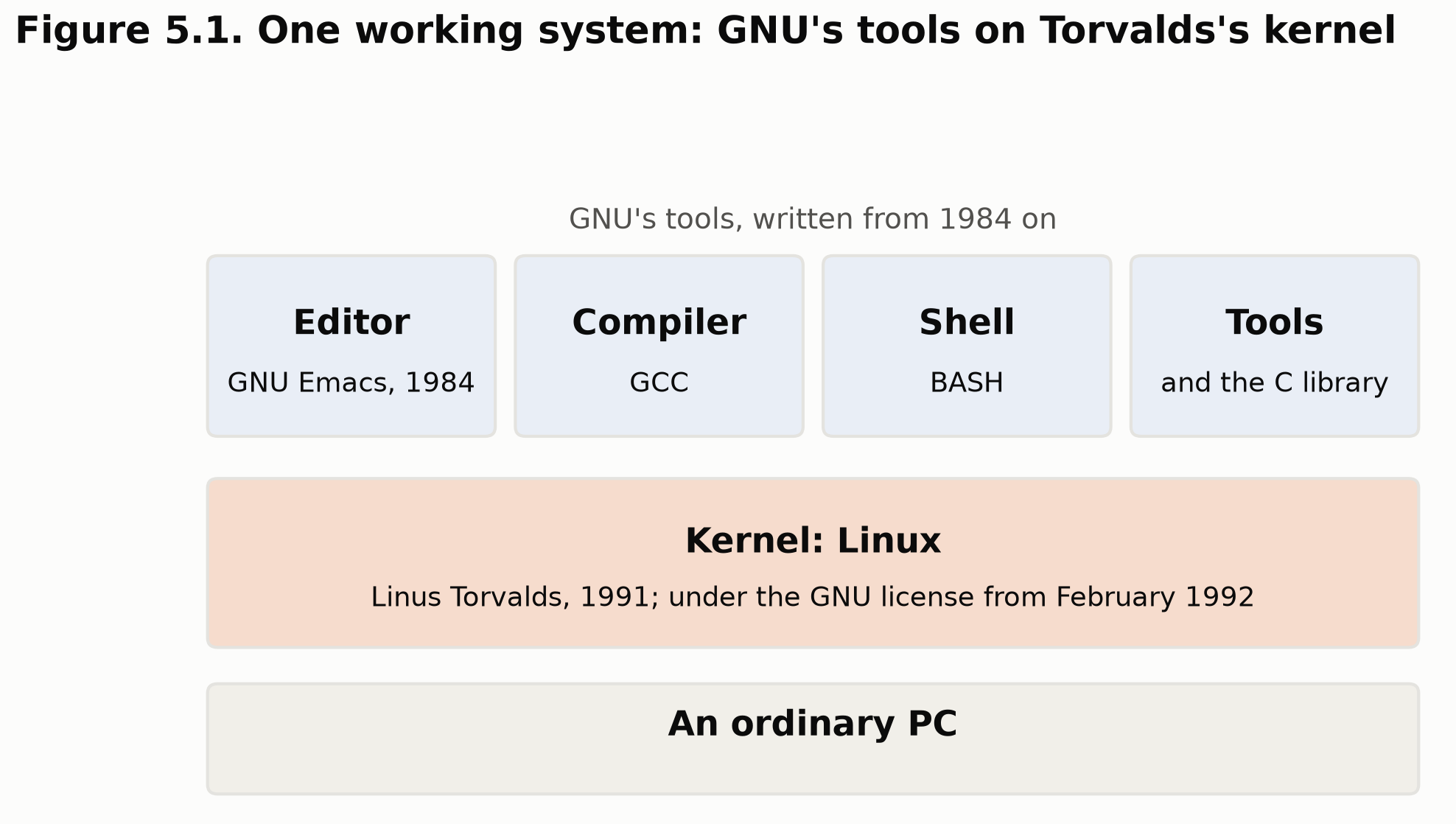
The pieces came one at a time. Stallman began a text editor, GNU Emacs, in September 1984, and mailed copies on tape to anyone who asked, for $150.4.9 In 1985 he started the Free Software Foundation, a charity that paid programmers to write more of the system.4.10 Stallman wrote the compiler, the program that turns a programmer's code into a working program, and it became GCC.4.11 Foundation programmers added the library that connects programs to the system, and Brian Fox wrote BASH, the shell where a person types commands.4.12
Stallman also protected the work with a license. He called the idea copyleft: anyone may run, copy, change and pass on the program, and each person who passes it on must hand over the same freedoms. The GNU General Public License put that bargain in writing.4.13 He wrote it after watching companies take free programs from MIT and lock them inside their own products.4.14
By 1990, GNU had almost everything a working system needed: the editor, the compiler, the shell and the tools.4.15 It lacked the kernel, the central program that runs the machine and every other program on it. The GNU kernel, called the Hurd, proved hard to finish. "Making the Hurd work solidly has stretched on for many years," Stallman wrote.4.16 His 1983 plan also promised a window system, and he later chose to use MIT's X instead of writing one.4.17
So the lab that lost its community built nearly a whole free system in answer. The kernel, and later the desktop, came from strangers.
The machine underneath
On August 25, 1991, Linus Torvalds, a student at the University of Helsinki in Finland, posted a short note to an online group of people who used Minix, a small operating system professors used for teaching.5.1 "I'm doing a (free) operating system (just a hobby, won't be big and professional like gnu) for 386(486) AT clones," he wrote, meaning the ordinary IBM-style PCs of the day.5.2 He added: "Yes - it's free of any minix code."5.3 He announced a hobby, not a revolution.
He was writing a kernel, the program at the center of a computer that hands out the processor, the memory and the disk to every other program. A kernel alone doesn't make a computer useful. A person also needs a compiler, an editor, a shell and the small tools that copy files and list folders. Stallman's GNU project had written those tools and given them away, and it lacked a working kernel. Torvalds supplied the missing piece.
Put GNU's tools on top of Torvalds's kernel, and a person had a complete operating system, free to copy, that ran on an ordinary PC. Stallman asked that the result be called GNU/Linux, because so much of it came from GNU. The GNU project put it gently: "You can't make others say 'GNU/Linux,' but you can decide to call the system 'GNU/Linux' yourself."5.4 Most people said Linux, and the argument goes on.
The project grew up in public arguments. On January 29, 1992, Andrew Tanenbaum, the professor who wrote Minix, posted a message titled "LINUX is obsolete."5.5 Torvalds had built his kernel as one large program, and Tanenbaum preferred a small core with the other parts running separately. "To me, writing a monolithic system in 1991 is a truly poor idea," he wrote.5.6 To the student, he added: "Be thankful you are not my student."5.7 Torvalds fired back the same day, calling Tanenbaum's position "one hell of a good excuse for some of the brain-damages of minix."5.8
The next day, Torvalds apologized. "I over-reacted, and am now composing a (much less acerbic) personal letter to ast," he wrote, using Tanenbaum's initials.5.9 The quarrel cooled quickly, but the pattern stuck. Two men argued about how to build an operating system, anyone with a modem read every word, and strangers who agreed with one side or the other found the code and joined in.
Torvalds also chose a license. His release notes said the GNU copyleft "takes effect as of the first of February," 1992.5.10 From then on, anyone could copy Linux, change it and pass it on, and anyone who passed on a changed version had to share the changes under the same terms. A programmer in one country could fix a problem, post the fix and know the work would stay open to everyone.
Linux 1.0 came out in March 1994, with about 170,000 lines of code.5.11 Its credits file listed 80 people and called itself "at least a partial credits-file."5.12 Three years after a student's hobby note, eighty people had their names on a working operating system. It took no code from AT&T's Unix, so it couldn't claim the Unix name. It worked like Unix, and it belonged to everyone who used it.
The room Linux walked into
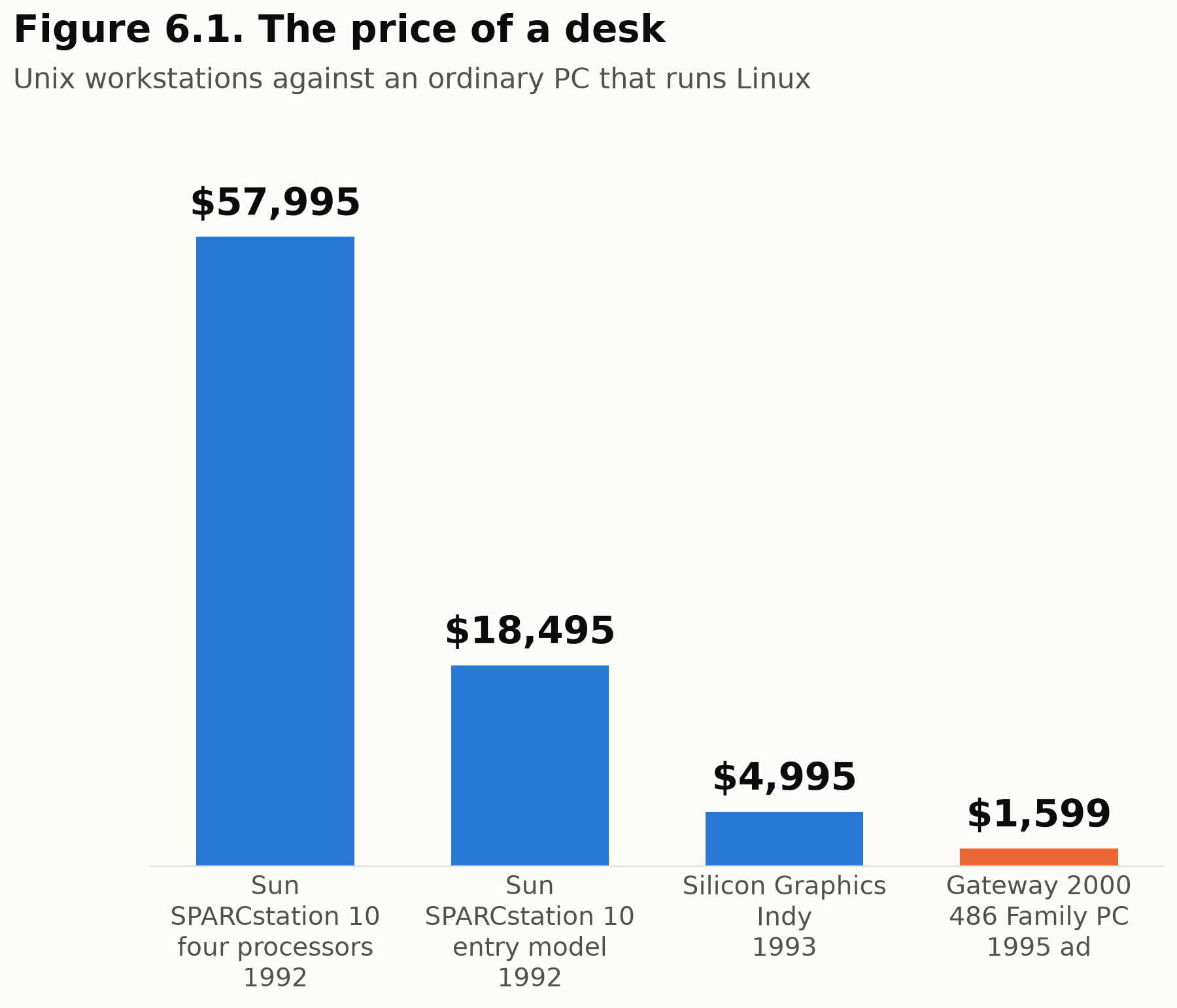
In the early 1990s, a serious Unix computer cost serious money. Sun Microsystems priced its SPARCstation 10 workstation, a desktop computer built for engineers, from $18,495 to $57,995 in 1992.6.1 Silicon Graphics aimed lower with its Indy, at $4,995 for an early model.6.2 A Gateway 2000 486 Family PC, the kind a student or a small business might buy, sold for $1,599 in a magazine ad of February 1995.6.3 Linux grew up in the space between those prices.
The companies selling the expensive machines spent the late 1980s fighting each other. In 1988 AT&T, which owned the original Unix, and Sun, the leading workstation maker, planned to merge their versions into one.6.4 Their rivals took it as a threat. On May 17, 1988, seven of them, Apollo, Groupe Bull, Digital Equipment, Hewlett-Packard, IBM, Nixdorf and Siemens, founded the Open Software Foundation to build a competing Unix.6.5 Around the industry, people joked that the initials OSF stood for "oppose Sun forever."6.6 The vendors split into two camps, and customers who wanted one settled Unix watched them argue for years.
Then the fight moved to a courtroom. Programmers at the University of California, Berkeley had rewritten much of Unix and given their version away. A small company, Berkeley Software Design, sold a low-cost Unix for ordinary PCs built from that free code. In April 1992, Unix System Laboratories, the AT&T company that owned Unix, sued it.6.7 That July, the company added the University of California to the suit.6.8
The lawsuit hung over every free Unix built from Berkeley's code. A programmer who wanted a free Unix for a PC had to wonder which files a judge might take away, and the doubt lasted nearly two years. The parties settled on February 4, 1994.6.9 In the end, Berkeley lost little. Kirk McKusick, who managed Berkeley's releases, wrote that "three files were removed from the 18,000" in the release at the center of the case.6.10 What Berkeley lost was time.
Linus Torvalds saw what that timing meant for him. In an interview in late 1993 he said, "If 386BSD had been available when I started on Linux, Linux would probably never had happened."6.11 386BSD, the free Berkeley Unix for PCs, wasn't ready when he began in 1991.6.12 By the time the lawsuit ended, his kernel had a head start and a growing circle of volunteers.
Timing, as much as code, gave Linux its start. The workstation companies sold Unix at workstation prices and spent their energy on each other. The free Unix for cheap PCs sat under a lawsuit during the very years a student with an inexpensive PC needed something to run. Linux, free and clear of AT&T's code, walked into the room they left open.
The Unix that took the desktop
Steve Jobs left Apple in 1985 and started a new computer company, NeXT, aimed at universities.7.1 On October 12, 1988, NeXT showed its first machine.7.2 An MIT staff report the next day described it: "The $6,500 NeXT workstation is a black magnesium cube," with "a 25MHz Motorola 68030" processor inside.7.3 People called it the cube. Underneath, it ran Unix programs from Berkeley's branch of Unix, the branch AT&T later took to court.7.4
At CERN, the physics laboratory in Switzerland, Tim Berners-Lee used one. "I wrote the program using a NeXT computer," he wrote of the first web browser.7.5 By the end of 1990, he had the first web server and browser running at CERN.7.6 The World Wide Web started on a Unix cube.
Apple, meanwhile, couldn't finish its next system for the Mac. In the summer of 1996, Apple's chief executive, Gil Amelio, and its chief technology officer, Ellen Hancock, "pulled the plug on Copland, Apple's $500-million project to upgrade the Macintosh operating system," the Los Angeles Times reported.7.7 Apple needed a new foundation, and it went shopping. On December 20, 1996, it announced it would buy NeXT, for $400 million.7.8 The deal closed on February 4, 1997.7.9
Jobs came back to Apple with NeXT's system, and Apple turned it into the core of a new Mac. On March 16, 1999, Apple released that core as open source under the name Darwin, which anyone could read and change.7.10 Apple's engineers named its kernel XNU, and the company's own notes explain the joke: "XNU is an acronym for X is Not Unix."7.11 On March 24, 2001, Mac OS X went on sale in stores around the world.7.12 Ordinary people now carried a Unix home in a Mac, with a friendly Mac face on top.
Apple then did something no maker of a desktop Linux has done. It submitted its system for the official test that lets a product carry the UNIX trademark. The Open Group, which owns the name, registered Mac OS X 10.5 Leopard on May 18, 2007.7.13 Apple has kept the certification since, through macOS Sequoia and Tahoe.7.14
Apple succeeded where the volunteers struggled, for practical reasons. It built its own hardware, so the system and the machine fit together. It paid designers to make one desktop, not a choice of several. It also secured the programs people needed. On August 6, 1997, at Macworld in Boston, Microsoft promised it "will develop and ship future versions of its popular Microsoft Office productivity suite" for the Mac.7.15
So the Berkeley branch of Unix reached ordinary desks first, under Apple's name. A Unix with Microsoft Office, one look and hardware in the box sold in every mall. The Linux desktop, without a company behind it, waited.
A desktop for the people who built it
Through the 1990s, the people who used Linux also wrote it. They built the programs they needed, ran them on machines they put together, and fixed what broke. The system served them well, because they shaped it. It served almost everyone else poorly, because almost everyone else couldn't.
Picture an ordinary buyer trying Linux in 1998. Many inexpensive PCs came with a "winmodem," a modem that saved money by handing its work to the computer's main processor through software. The makers wrote that software for Windows. A Linux guide of the time explained that "until late 1999, such software was released only for MS Windows and wouldn't work with Linux."8.1 The buyer plugged in a modem, and Linux couldn't use it.
Sound took work too. To make a sound card play, a Linux user often had to build its driver, the small program that runs a piece of hardware, from source code. Writing a letter meant buying an office suite. WordPerfect 8 for Linux listed at $69.95.8.2 Applixware cost $49.95.8.3 In August 1999 Sun Microsystems bought the maker of StarOffice and gave it away.8.4
For photographs, Linux had the GIMP. Two Berkeley students, Spencer Kimball and Peter Mattis, started it in 1995.8.5 When the commercial toolkit they used for buttons and menus frustrated him, "Peter got really fed up with Motif. So he decided to write his own."8.6 His toolkit, GTK, matters later in this history. With Stallman's agreement, the General Image Manipulation Program became the GNU Image Manipulation Program.8.7 It worked, but it asked a newcomer to learn a great deal.
Games came from one company, Loki Entertainment, which brought Windows games to Linux. Loki filed for bankruptcy on August 2, 2001, and closed the next January.8.8
So the ordinary buyer went back to Windows. Developers stayed, because they wrote the tools they used. System administrators stayed, because their servers ran Unix. Universities stayed, because they taught with source code a student could read. Tom Adelstein, whose story opens this history, learned his first commands from posts other users left on mailing lists.8.9 That's how a person learned Linux then: from the people who built it.
The desktop sat in a trap. Ordinary people stayed away because the programs they needed weren't there. Software companies stayed away because ordinary people weren't there. For years, that trap kept the Linux desktop small, and kept it for experts.
Beowulf: sixteen PCs on a bench
In the summer of 1994, two engineers at NASA's Goddard Space Flight Center in Maryland built a supercomputer out of store-bought parts.9.1 Thomas Sterling and Donald Becker needed serious computing power for NASA's science work, without the multimillion-dollar price of a supercomputer from one of the specialist makers. They wired ordinary PCs together so they worked as one machine, a design called a cluster, and named it Beowulf, after the hero of the Old English poem.
The first Beowulf held sixteen PCs.9.2 Each had an Intel 486 processor running at 100 megahertz, 16 megabytes of memory and a 500-megabyte disk, the same parts anyone could order from a catalog.9.3 Sterling and Becker set them on a bench and ran Linux on every one, because they could copy Linux free and change whatever they needed.
The hard part was the network. A cluster runs only as fast as its machines can trade data, and the ordinary office network cable of the day moved data slowly. Becker wrote software that joined two or more network cables into one wider path, a method called channel bonding, and added it to Linux.9.4 The Linux kernel's documentation still credits him: "The bonding driver originally came from Donald Becker's beowulf patches."9.5 Becker had also written "most of the ethercard drivers" in Linux, according to its credits file, the code that let Linux use most of the network cards in the world.9.6
Other laboratories copied the design. At a supercomputing conference in 1996, "both NASA and DOE demonstrated clusters costing less than $100,000 that achieved greater than a gigaflop/s sustained performance," the Beowulf project records.9.7 A gigaflop means a billion calculations a second, a speed that once took a machine costing millions.
Meanwhile, volunteers carried Linux onto the expensive workstations the computer makers sold, each built around its maker's own processor. Hamish Macdonald and Greg Harp moved Linux to the Motorola chip in Amiga computers in July 1993.9.8 In March 1995, a team at Digital Equipment Corporation led by Jim Paradis moved to Torvalds's code for Digital's 64-bit Alpha chip.9.9 David S. Miller and Miguel de Icaza brought Linux to Sun's SPARC processor.9.10 Each new version came back into the shared code for everyone to use.
The workstation makers couldn't match a free system on cheap hardware. Sun Microsystems' revenue peaked at $18.3 billion in fiscal 2001 and fell to $11.1 billion by 2005.9.11 Oracle bought Sun for about $7.4 billion, completing the purchase in January 2010.9.12 Silicon Graphics, whose workstations drew movie effects, peaked at about $3.66 billion in fiscal 1997, went bankrupt twice, and sold what remained for $42.5 million in 2009.9.13 TechCrunch wrote that SGI had "fell victim to the spread of cheap Linux boxes hooked up together."9.14
Linux took the supercomputer, the server room and the engineer's workstation by running on inexpensive machines. One room held out: the desk at home and in the office, with its word processor and its games. Windows still ran there.
The one owned thing
Every desktop needs a toolkit, a shared library of buttons, menus and windows that each program draws from. Matthias Ettrich built his KDE desktop on a toolkit called Qt, from a small Norwegian company, Trolltech.10.1 Trolltech let people use Qt free of charge but kept one right for itself: anyone who changed Qt couldn't hand out the changed version.10.2 Almost everything else under the Linux desktop belonged to everyone. The toolkit belonged to one company, and that one owned thing split the free desktop in two.
The other toolkit came from a photo editor. The two Berkeley students who started the GIMP first built it on a commercial toolkit, and in November 1995 Peter Mattis admitted that "the biggest restriction to running the GIMP is the Motif requirement."10.3 So he wrote his own toolkit, GTK, free for anyone to use.10.4 By January 1997, he wrote, the program had been "dubbed GNU software by Richard Stallman (with our agreement)."10.5
On August 15, 1997, Miguel de Icaza, a young programmer, proposed a second free desktop on the GTK mailing list. He called it GNOME, and described the goal as "a free and complete set of user friendly applications and desktop tools, similar to CDE and KDE but based entirely on free software."10.6 CDE was the desktop sold with commercial Unix. De Icaza named his objection to KDE plainly: it had "selected the non-free Qt toolkit as the foundation for the project, which poses legal problems for those desiring to redistribute the software."10.7 GNOME would stand on GTK, the toolkit a photo editor left behind. Stallman's GNU Project backed GNOME, and also started a project called Harmony to rewrite Qt as free software.10.8
Trolltech gave ground. In November 1998 it loosened Qt's license, though not enough to settle the argument.10.9 In September 2000 it put Qt under Stallman's own GNU General Public License.10.10 "Qt, now also GPL!" the KDE news site announced on September 5, 2000.10.11 The legal problem de Icaza raised three years earlier was gone.
The split stayed. That same day, Stallman wrote that "the design of KDE was based on a fundamental mistake," and predicted: "GNOME and KDE will remain two rival desktops, unless some day they can be merged."10.12 The KDE developers answered the same day, calling his case "rather absurd reasoning" and adding, "We maintain, as always, that there are no licensing problems with KDE."10.13
The two desktops never merged. Today a Linux user can choose GNOME, KDE or one of several others built later. That choice goes back to one company's terms on a toolkit in 1996, terms that ended in 2000.10.14 The rivalry outlived them.
The applications decide
People buy a computer to run programs, and they choose the machine that runs the programs they need. Through the 1990s, Microsoft understood that rule better than anyone. The desktop followed the software, and Microsoft held the software most people used.
Engineers saw it first. Microsoft built Windows NT as its serious system for workstations, the powerful desktop computers engineers used. In August 1993, Parametric Technology Corporation began shipping a Windows NT version of Pro/ENGINEER, its design program.11.1 CAD historian David Weisberg explained why the move suited PTC: the company "received the same revenue for Pro/ENGINEER whether it ran on a $40,000 UNIX workstation or a $4,000 PC."11.2 The program cost the same, and the machine under it cost a tenth as much.
The rest of the trade followed. Intergraph, a workstation maker, decided in late 1992 to move to Intel chips and Windows.11.3 Dassault Systèmes announced CATIA, the program aircraft and car designers used, for Windows NT in October 1998.11.4 Silicon Graphics announced its own Windows NT workstations in January 1999.11.5 That July, the research firm IDC reported that "Intel-based Windows NT workstations have been outshipping Unix workstations since last year."11.6
One group went the other way. The engineers who design computer chips had worked on Unix for years, and the companies that wrote their software, Cadence, Synopsys and Mentor Graphics, chose Linux, which gave them Unix on inexpensive Intel machines. By February 17, 2004, all three had standardized on Red Hat Enterprise Linux.11.7 The applications decided there too, and they decided for Linux.
The office held for Microsoft through two programs. Exchange ran a company's mail and calendars on a server in the back room, and Outlook showed them on every desk. Outlook worked fully only with Exchange, so a company that wanted Linux on its servers had to keep Exchange.
IBM had just bet heavily on Linux. On December 12, 2000, its chief executive, Louis Gerstner, said "his company will spend $1 billion on Linux next year," across "PCs, portables, servers and mainframes."11.8 Near the end of 2000, IBM showed it could run a thousand copies of Linux on one mainframe. As Tom Adelstein wrote later, "IBM needed an application that made Linux a host that reached further into mainstream computing. So they made a call on us."11.9
Adelstein, whose story opens this history, went straight at that lock. His company, Bynari, built a mail server on Linux and a connector for Outlook. An IBM case study described the result: "letting employees use Outlook on their PCs while connecting with their non-Microsoft e-mail servers."11.10 In April 2001, as Adelstein wrote later, "Bynari, Inc. became IBM's first Linux Influencer Partner."11.11 Bynari left Windows on the desk and moved the work behind it to Linux.
The browser came next. Netscape's Navigator opened the web to ordinary people and held 72 percent of the browser market in 1997.11.12 Microsoft gave its own browser away with Windows and took the market back. On March 31, 1998, Netscape released its source code, the start of the Mozilla project.11.13 On November 5, 1999, a federal judge, Thomas Penfield Jackson, found that "Microsoft enjoys monopoly power" over the operating systems of personal computers, with a share of "at least ninety-five percent."11.14
So by the end of the decade, the rule held everywhere. The desktop went where the applications went. Engineers who needed design software went to Windows, chip designers went to Linux, and the office stayed with the programs Microsoft owned.
The hinge: Red Hat takes the backend
Red Hat sold Linux in boxes on store shelves beside Windows through the late 1990s. Its people also saw where the money lay. They told Tom Adelstein, in his words, "that Microsoft had the desktop but they didn't have the server market."12.1 Microsoft held the desk in front of the worker. The servers behind it, the computers that run a company's websites, mail and records, stayed open.
On August 11, 1999, Red Hat went public, the first Linux company to do so.12.2 Salon called it "a successful IPO for Red Hat, the first Linux company to go public."12.3
Then Red Hat made its choice. On March 26, 2002, it launched Advanced Server, a Linux for corporations, sold with support, which became Red Hat Enterprise Linux.12.4 In July 2003, Red Hat announced the end of the boxed Red Hat Linux for home users.12.5 That September, the home version passed to a community project, Fedora, which Red Hat described as a "proving ground for technology that may eventually make its way into Red Hat's fully-supported commercial solutions."12.6 Red Hat Linux 9 became the last of the line.12.7
In 2008, Red Hat said it outright. On April 16, its desktop team wrote: "We have no plans to create a traditional desktop product for the consumer market in the foreseeable future."12.8 The team gave its reason: "The desktop market suffers from having one dominant vendor, and some people still perceive that today's Linux desktops simply don't provide a practical alternative."12.9
The backend rewarded the choice. Linux came to run the servers, then the cloud, then the supercomputers. In June 2017, Linux ran 498 of the world's 500 fastest computers. That November, it ran all 500.12.10
On October 28, 2018, IBM announced it would buy Red Hat for about $34 billion.12.11 The deal closed on July 9, 2019.12.12
The money followed the backend. Companies came to pay the programmers who wrote most of Linux's central code. The desktop, set aside by the company best placed to sell it, waited for someone else to take it up.
Linux for human beings
Mark Shuttleworth had money before he had a Linux company. He built Thawte, a South African company that sold the digital certificates websites use to prove who they are, and on December 19, 1999, VeriSign agreed to buy it for stock worth $575 million.13.1 InternetNews called the sale "a major coup for Thawte's 26-years-old chief executive Mark Shuttleworth."13.2 On April 27, 2002, he arrived at the International Space Station aboard a Russian Soyuz, as a paying space traveler.13.3
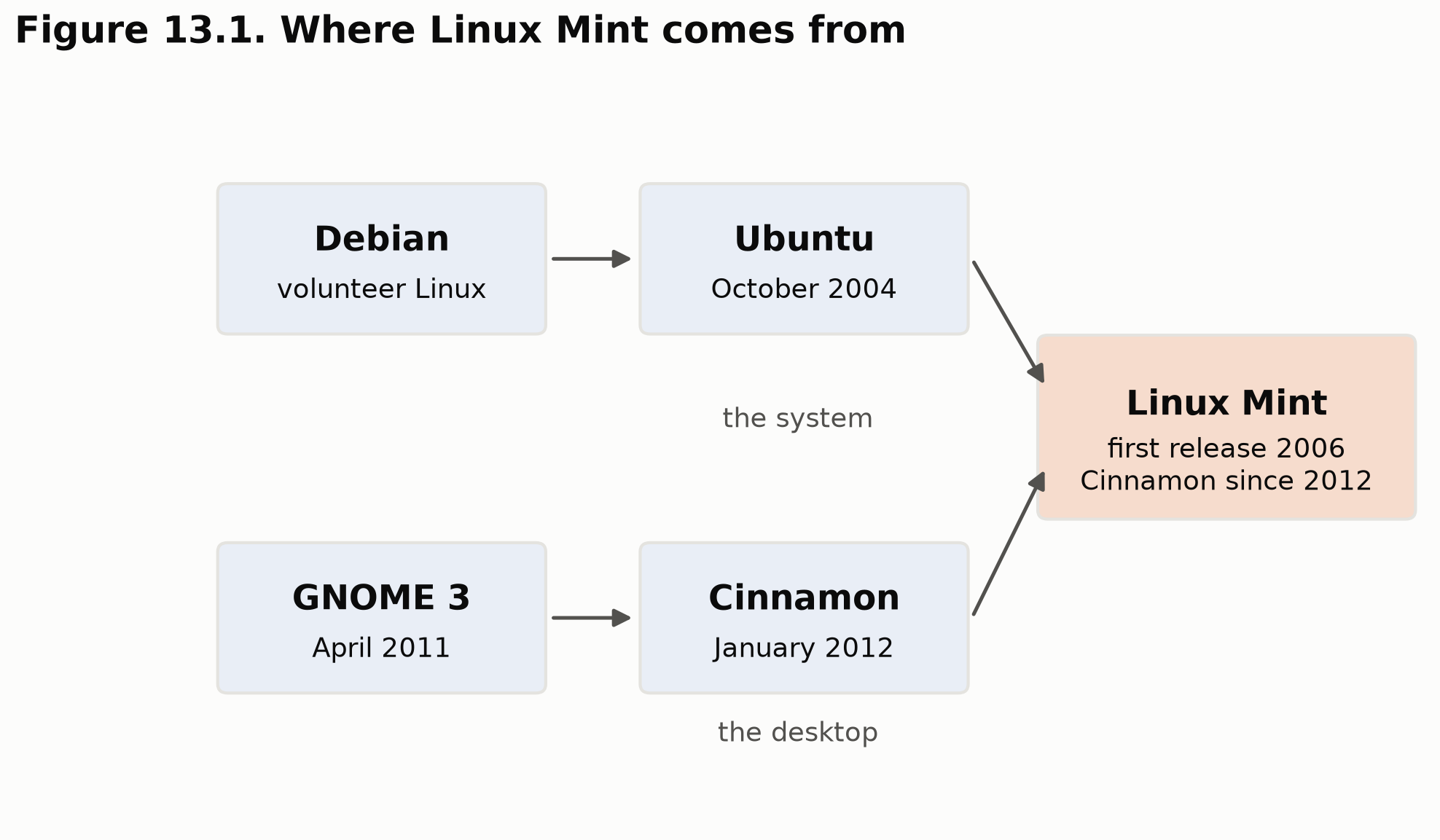
Back on Earth, Shuttleworth went after the desktop the server companies left alone. In 2004 he founded Canonical, and on October 20, 2004, he announced its first release, Ubuntu 4.10.13.4 He wrote that he was "proud to present the very first release of Ubuntu!"13.5 Ubuntu built on Debian, a large volunteer-run version of Linux, and aimed at ordinary people. Its tagline, used until 2010, said so: "Linux for Human Beings."13.6
Two months before the release, Shuttleworth stated his goal in an unusual place. On August 20, 2004, he opened the first entry in Ubuntu's bug tracker, the list where programmers record problems to fix, and titled it "Microsoft has a majority market share."13.7 He wrote: "This is a bug which Ubuntu and other projects are meant to fix."13.8 He left Bug #1 open for nine years.13.9
Canonical also mailed Ubuntu to anyone who asked. The first announcement promised, "If you want a shrinkwrapped CD we will gladly ship it to you at no cost."13.10 The free disc program, called ShipIt, ran until April 2011.13.11 For a person on a slow dial-up line, a free disc in the mailbox made trying Linux easy.
Ubuntu's work on an easy desktop gave others something to build on. In August 2006, Clement Lefebvre released Linux Mint 1.0, based on a version of Ubuntu.13.12 Mint's own history records that "In August of 2006, Linux Mint 1.0 'Ada', based on Kubuntu 6.06 was released."13.13 Mint kept Ubuntu's foundations and aimed at people who wanted a desktop that worked as soon as they installed it. Mint is the system Introduction to Linux, the first book in this series, teaches.
Canonical later reached for phones and a new interface of its own, then pulled back. On April 5, 2017, Shuttleworth wrote, "we will end our investment in Unity8, the phone and convergence shell. We will shift our default Ubuntu desktop back to GNOME for Ubuntu 18.04 LTS."13.14 By then he had closed Bug #1. On May 30, 2013, he wrote, "So from Ubuntu's perspective, this bug is now closed," with Apple's iOS and Google's Android sharing a market that no longer belonged to one company.13.15
Red Hat set the desktop aside. Canonical carried it to ordinary people, and Linux Mint, built on Canonical's work, made it feel familiar to anyone coming from Windows.
Building the plumbing
A desktop that couldn't play sound, join a network or draw a window without a fight needed more than applications. It needed plumbing, the hidden parts that connect a computer's hardware to its programs. Over twenty years, mostly paid engineers fixed the problems of 1998 one at a time.
Havoc Pennington, a programmer at Red Hat, started with agreement. "At the start of the month I quietly launched a small project called the X Desktop Group," he wrote in April 2000.14.1 Renamed freedesktop.org, it gave the rival desktop projects a neutral place to write shared standards, so a program built for one desktop could work on another.
In 2004, two more programmers took on the worst daily annoyances. Havoc Pennington asked Dan Williams, also of Red Hat, to look at "making networking not suck," and Williams began NetworkManager on June 24, 2004.14.2 It gave Linux one tool for joining wired and wireless networks, a job that once meant editing settings files by hand. Lennart Poettering began PulseAudio on June 8, 2004.14.3 It let more than one program play sound at once and sent sound to the right speakers or headphones. In 2008, Kristian Høgsberg began Wayland, a simpler replacement for X, the system that had drawn windows on Unix screens since 1984.14.4
The programmers needed a place to share their code. In November 1999, VA Linux, a company that sold computers with Linux installed, opened SourceForge, where any free project could store its code, track its bugs and offer downloads.14.5 Thousands of projects moved in.
The Linux kernel itself relied on a borrowed tool. Its developers tracked their changes with BitKeeper, a commercial program its maker let them use free. In April 2005 the maker withdrew that arrangement, and Linus Torvalds wrote a replacement.14.6 "Torvalds famously wrote Git in just 10 days," GitHub later recounted.14.7 Git spread from the kernel to most of the world's programmers. In April 2008 a new company, GitHub, built a website around Git that made sharing code as easy as sharing a link.14.8 Microsoft bought GitHub on June 4, 2018, for $7.5 billion.14.9 The kernel developers still take their changes by email.14.10
The last piece of plumbing started the loudest fight. On April 30, 2010, Poettering announced systemd, a new first program for a Linux computer to run at startup, the one that starts every other program.14.11 It started services faster, and it took on many other jobs, which some developers thought too much for one program. In February 2014 the committee choosing Debian's default split evenly, and its chairman, Bdale Garbee, cast the deciding vote: "the default init system for Linux architectures in jessie should be systemd."14.12 That November a group of objectors announced Devuan, a copy of Debian without systemd.14.13
Companies paid for most of this work. In 2015 the Linux Foundation counted that "a conservative calculation shows this number at 80 percent," the share of kernel developers paid for their work.14.14 Red Hat paid Pennington, Williams and Høgsberg.14.15 A working desktop served those companies' own ends, and they built one.
The result arrived quietly. A Linux desktop that once struggled to play sound or find a network now does both before its user thinks to ask.
Designers decide for the user
With paid engineers came something the volunteer desktop rarely had: people willing to decide what the desktop should do for its users. Some of those decisions helped millions. One went too far, and the way Linux users answered it shows what holding the code means.
The first big decision came from a law. In 1998 Congress amended the Rehabilitation Act with Section 508, which took effect in 2001 and told federal agencies to buy electronic technology that people with disabilities could use.15.1 Sun Microsystems sold computers with the GNOME desktop to the government, so Sun paid for the work.15.2 Its guide to GNOME 2.0 named the reason: "Recent legislation such as Section 508 of the U.S. Rehabilitation Act also heightens awareness of the need to provide accessible software."15.3 By 2004 Marc Mulcahy had written Orca, a screen reader that speaks the screen aloud for blind users.15.4 After Oracle bought Sun in 2010, Oracle laid off members of the accessibility team, and its leader, Will Walker, kept working on Orca as a volunteer.15.5
Then GNOME's developers wrote down a design philosophy. In April 2002 Havoc Pennington argued in an essay that a good program should "do something specific and do it well," and that "using preferences as a band-aid is the root of much UI evil," because "more preferences means fewer real features, and more bugs."15.6 That August, GNOME published its Human Interface Guidelines, rules for how its programs should look and behave: fewer options, clearer choices, designers deciding so users needn't.15.7
In April 2011, GNOME's designers carried that idea further than many users wanted. GNOME 3.0 removed the taskbar, the strip along the bottom of the screen that shows open windows.15.8 "Every window in GNOME 3 has only one button - the close button," The Register reported.15.9 In its place, a person opened a full-screen view to find programs and windows.15.10
Many users wanted their desktop back, and because they held the code, they took it back. On June 18, 2011, a developer who goes by Perberos announced: "I've made a GNOME2 fork. I've called it 'Mate'."15.11 A fork is a copy of a program's code that a new group develops on its own. MATE kept the old GNOME desktop alive. On January 2, 2012, Clement Lefebvre of Linux Mint introduced Cinnamon, built on GNOME 3's new machinery with the familiar layout restored: a menu, a taskbar, and buttons to shrink and enlarge windows.15.12 Linux Mint ships Cinnamon today.15.13
A year later, Microsoft's designers made the same kind of choice. Windows 8, released October 26, 2012, removed the Start menu.15.14 Windows users couldn't copy Windows and restore it themselves. They waited for Windows 10. Announcing it in September 2014, Microsoft wrote: "The familiar Start menu is back."15.15
The pattern goes back to the beginning of this history. In the early 1980s, the Xerox Star's designers watched users and decided that windows "should be constrained so as not to overlap."15.16 The Star's designers decided for the user, and so did GNOME's and Microsoft's. On Linux, the users held the code, so the users had the last word.
Microsoft's turns
From Vista to Windows 10, each new Windows gave people another reason to look around.
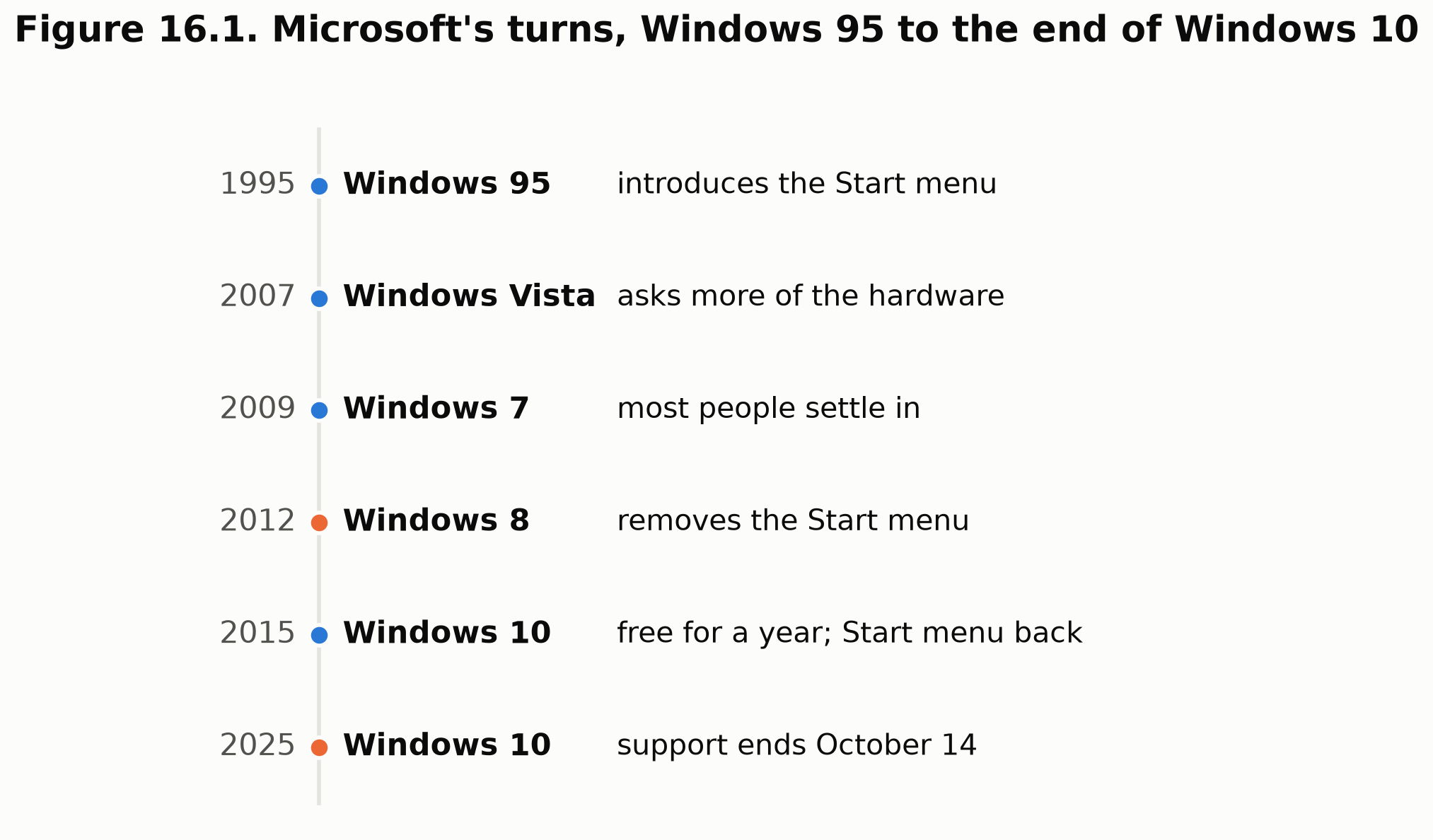
Microsoft released Windows Vista to consumers on January 30, 2007, calling it "the most significant product launch in Microsoft Corp.'s history."16.1 Vista asked more of a computer than many owners had. In a 2008 class action over the "Vista Capable" sticker, Computerworld reported that the label "was slapped on systems that could run only the lowest-priced and lowest-powered version" of Vista.16.2 Steve Ballmer, Microsoft's chief executive, later told TechRadar that Vista was the thing he regretted most.16.3
Windows 7 followed on October 22, 2009, and most people settled into it.16.4 Then, on October 26, 2012, Microsoft shipped Windows 8 and replaced the Start menu, the corner menu Microsoft introduced with Windows 95,16.5 with a screen full of tiles.16.6 Users pushed back hard. Windows 8.1 put back a Start button, but as TechCrunch noted, "There's no Windows 7-like pop-up menu."16.7
On September 30, 2014, Terry Myerson, who ran Windows, announced Windows 10 and promised that "the familiar Start menu is back."16.8 On January 21, 2015, he added that "a free upgrade for Windows 10 will be made available to customers running Windows 7, Windows 8.1, and Windows Phone 8.1 who upgrade in the first year."16.9 Windows 10 came out on July 29, 2015, and the free offer ran for a year.16.10
Myerson said the company wanted "to redefine the relationship we have with you – our customers" and to treat "Windows as a Service."16.11
Tom Adelstein, who watched the market from the Linux side, reads it this way: "I think Windows 10 was an answer to Ubuntu."16.12 By 2015, Ubuntu had given away a complete desktop for eleven years, and Linux Mint had grown up on top of it.16.13 Microsoft's own annual report for that year pointed at the same pressure in general terms: "competing with operating systems licensed at low or no cost may decrease our PC operating system margins."16.14 The report named Apple and Google as its main desktop competitors, and the press of the day tied the free upgrade to Apple's free OS X Mavericks in 2013 and to Android.16.15 On the Linux side, Christine Hall wrote in FOSS Force that the free upgrade "also lets Microsoft compete with Linux on price."16.16
Whatever moved Microsoft, the free upgrade showed what a free system had done to the price of a desktop. A company that once sold Windows to every PC buyer gave the next version away.
The battlefield moves
While the desktop camps argued, the world began looking at a smaller screen. On January 9, 2007, Apple announced the iPhone, and it went on sale that June.17.1 Underneath, it ran software from Darwin, the same Unix core as the Mac.17.2 On September 22, 2008, T-Mobile announced the G1, "the First Phone Powered by Android," built by HTC with software from Google.17.3 "Android relies on Linux version 2.6 for core system services," Google's developer page explained.17.4 The Linux kernel, the program at the center of every Linux system, now ran on a phone a person could buy at the mall.
The kernel developers didn't welcome Android at first. Google and the phone makers wrote their changes off to the side, and on December 11, 2009, Greg Kroah-Hartman, a leading kernel developer, removed Android's code from the kernel's holding area for unfinished work.17.5 "No one cared about the code, so it was removed," he explained.17.6 The work came back over the next few years. Android's code returned in December 2011, and by early 2015 a key piece moved into the main kernel.17.7 "Might as well move it to the 'real' part of the kernel," Kroah-Hartman wrote.17.8
Then the numbers turned. In April 2017, StatCounter, which measures web traffic, reported that in March, Android had passed Windows in share of internet use worldwide, 37.93 percent to 37.91.17.9 Windows still led on desktop computers. "Windows won the desktop war but the battlefield moved on," said Aodhan Cullen, StatCounter's chief executive.17.10
Mark Shuttleworth saw it too. On May 30, 2013, he closed Ubuntu's Bug #1, "Microsoft has a majority market share," pointing to iOS and Android as "a meaningful share" of the market.17.11 "So from Ubuntu's perspective, this bug is now closed," he wrote.17.12 Canonical tried to put Ubuntu on phones as well, then stopped. On April 5, 2017, Shuttleworth wrote: "we will end our investment in Unity8, the phone and convergence shell."17.13
So the phone carried the Linux kernel into phones around the world, and the fight for the desktop stopped being the fight that mattered most. The desktop kept its place on the office floor and the kitchen table, where people still write, keep their books and do their work.
Whose machine
By the 2020s, the same Linux kernel ran two kinds of machines. On many phones, it answered to the company that made the phone. On a desktop or laptop running Linux, it answered to the person who owned it. The difference came down to who held the keys.
Samsung sold Galaxy phones in the United States and Canada with a locked bootloader, the small program that starts the phone and chooses which system to load. "Samsung Galaxy devices with a Snapdragon chipset that are sold in the USA and Canada come with a non-unlockable bootloader," one independent guide explains.18.1 Samsung added a hardware fuse called the Knox Warranty Bit, which Samsung's own paper describes as "a one-time hardware e-fuse, permanently marking the device as having a non approved configuration."18.2 An owner who loads unapproved software trips it for good, and Samsung's payment and work features stop trusting that phone.18.3
A few small projects pushed the other way. In May 2017 a developer started postmarketOS, "aiming for a 10 year life-cycle for smartphones," so owners could keep old phones running with a standard Linux system after the maker stopped sending updates.18.4 Purism, a small American company, built the Librem 5, a phone that runs free software and turns into a desktop when its owner plugs in a monitor and keyboard: "once you dock it, all the adaptive applications become the same full-sized Linux desktop applications."18.5 Pine64 sold the PinePhone inexpensively and said it "is capable of running mainline Linux."18.6
Samsung opened the door once, briefly. In November 2018 it started a test program called Linux on DeX, which let a Galaxy phone run Ubuntu on a monitor and keyboard.18.7 In October 2019 it told testers, "we are announcing the end of our beta program."18.8 It never sold the feature as a finished product.
Games told the same story. For years, a person who wanted to play the big commercial games needed Windows. Then, on August 21, 2018, Valve, which runs the Steam game store, announced Proton, "a modified distribution of Wine," the free project that runs Windows programs on Linux.18.9 A Linux user could now buy a Windows game on Steam and play it. In February 2022 Valve began shipping the Steam Deck, a handheld gaming computer that runs SteamOS, Valve's own Linux system. Valve's own answers for buyers say, "Multi-boot is supported - you can have multiple OSes installed and choose which one to boot into."18.1018.11
The Steam Deck and a Galaxy phone run the same kernel. Samsung's fuse says the phone belongs to Samsung. The Steam Deck, like a Linux desktop, belongs to the person who bought it.
What the fights left behind
The Linux desktop grew from other people's fights, and it kept the tools those fights left behind. Each tool arrived as a by-product of someone solving a different problem, and each came free.
A photo editor left a toolkit. Peter Mattis wrote GTK because the commercial toolkit frustrated him: "Peter got really fed up with Motif. So he decided to write his own."19.1 Programmers far beyond the GIMP now build their windows with it, and the GNOME desktop stands on it.
A withdrawn license left Git. When BitKeeper's maker ended the kernel developers' free use of its tool in 2005, Linus Torvalds wrote his own, and the world's programmers now keep their code in it.19.2
A lost browser war left a programming language. Netscape released its browser's code in 1998, and Mozilla grew from it.19.3 Mozilla took up a programmer's side project, Graydon Hoare's Rust, a language designed to catch common memory mistakes before a program runs.19.4 In 2010 Hoare called it a "spare-time kinda thing" that "a small group of people in Mozilla got interested in."19.5 The Rust team released version 1.0 on May 15, 2015.19.6
In October 2022, kernel developer Kees Cook asked Torvalds to "pull the initial Rust support for v6.1-rc1," and Linux 6.1 shipped with it that December.19.7 "For the first time in Linux's history, in addition to C, you'll be able to use another language, Rust," The Register wrote.19.8 At the 2025 Maintainers Summit, the kernel's leaders agreed, as LWN reported, that "Rust in the kernel is no longer experimental — it is now a core part of the kernel and is here to stay."19.9 The company that lost the browser war paid for the language now going into the system beneath every Linux desktop.
The fighting goes on too. Wedson Almeida Filho left the Rust for Linux project in August 2024, tired of "the nontechnical nonsense."19.10 In February 2025, Hector Martin, who led the work to run Linux on Apple's own chips, stepped down as a kernel maintainer after a public clash with Torvalds.19.11
The oldest argument left a name. Richard Stallman still asks people to say GNU/Linux, since GNU built most of the system and Linux the kernel.19.12 The GNU Project's own answer stays patient: "You can't make others say 'GNU/Linux,' but you can decide to call the system 'GNU/Linux' yourself."19.13
A toolkit from a photo editor, a tool from a withdrawn license, a language from a lost browser war: the Linux desktop collected each one, given away, from work done for other reasons.
Stranded on a date
On October 14, 2025, Microsoft ended support for Windows 10.20.1 "Windows 10 will reach end of support on October 14, 2025," its lifecycle page said.20.2 After that day, Windows 10 stopped receiving the fixes that keep a computer safe to use online.
Windows 11, the replacement, turned away many of the computers that ran Windows 10. Microsoft's list of supported Intel processors for Windows 11 starts with Intel's 8th generation of Core chips.20.3 A computer built around a 7th-generation chip, a line Intel introduced in August 2016,20.4 fails the test, though it still does its work. Zorin, a small Linux company, cited an estimate that "an estimated 240 million computers" couldn't meet Windows 11's requirements.20.5
The man leading Microsoft through that change came to the job from the company's server business. Satya Nadella became chief executive on February 4, 2014, after running Microsoft's Cloud and Enterprise group, and before that the division that sold servers and tools to companies.20.6
Tom Adelstein, whose story opens this history, keeps a Dell Inspiron 5567 laptop on his bench. Its processor, an Intel Core i5-7200U, belongs to the 7th generation, so Microsoft's list leaves it out.20.7 Windows 11 also requires a security chip called a TPM, short for Trusted Platform Module.20.8 On October 13, 2026, Adelstein switched on the laptop's built-in TPM in its setup screen, and Linux reported a working "TPM 2.0 Device."20.9 The laptop had the chip Windows 11 demands all along. Microsoft's list rejected its processor's generation.
So he installed Linux Mint on it. He encrypted the disk, so the files on a lost laptop stay locked, and the laptop starts with Secure Boot turned on.20.10 The computer Windows 11 refused now runs a current, encrypted, supported desktop.
He went further and made it a secure endpoint, the kind of computer a business can trust on its network with its records. To sign in, and again before any change to the system, a person types a password and touches a small hardware key plugged into the laptop.20.11 A firewall turns away connections the owner didn't allow, and the laptop accepts remote sign-ins only by key, never by password.20.12 Each night a backup copies its files to another machine, and before the disk was erased, the lab restored files from that backup to prove it worked.20.13 Every piece of it came free, on a laptop Windows 11 turned away.
The feeling of being stranded reaches past computers. On September 18, 2026, the President signed Executive Order 14431, which directs federal agencies weighing work-visa petitions to "take into account" whether the employer "engaged in layoffs within the previous year or plans future layoffs" affecting American workers in similar jobs.20.14 The order's own findings say technology employers laid off "somewhere between 800,000 to 1.3 million American employees from 2022 through 2026."20.15 Working engineers, like owners of refused laptops, watched decisions about their future arrive from somewhere else, on someone else's date.
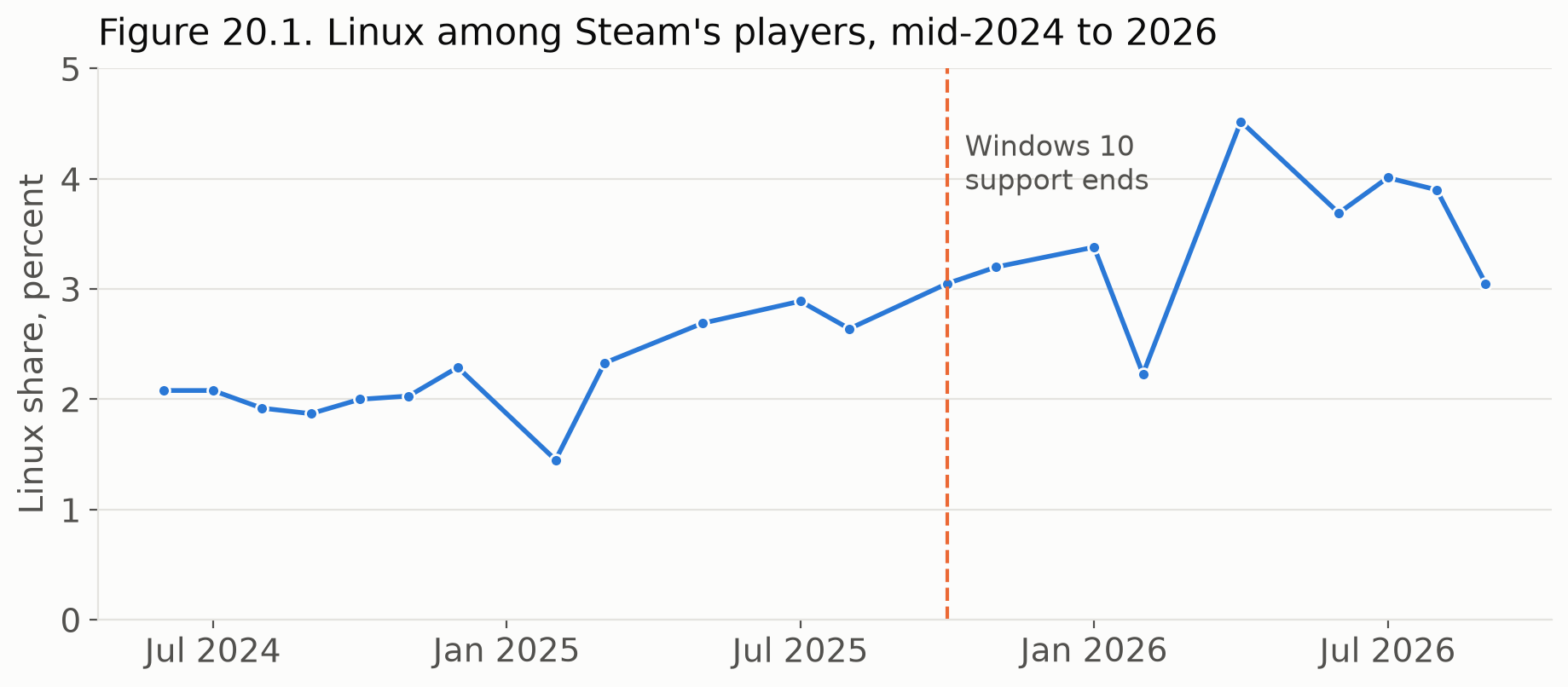
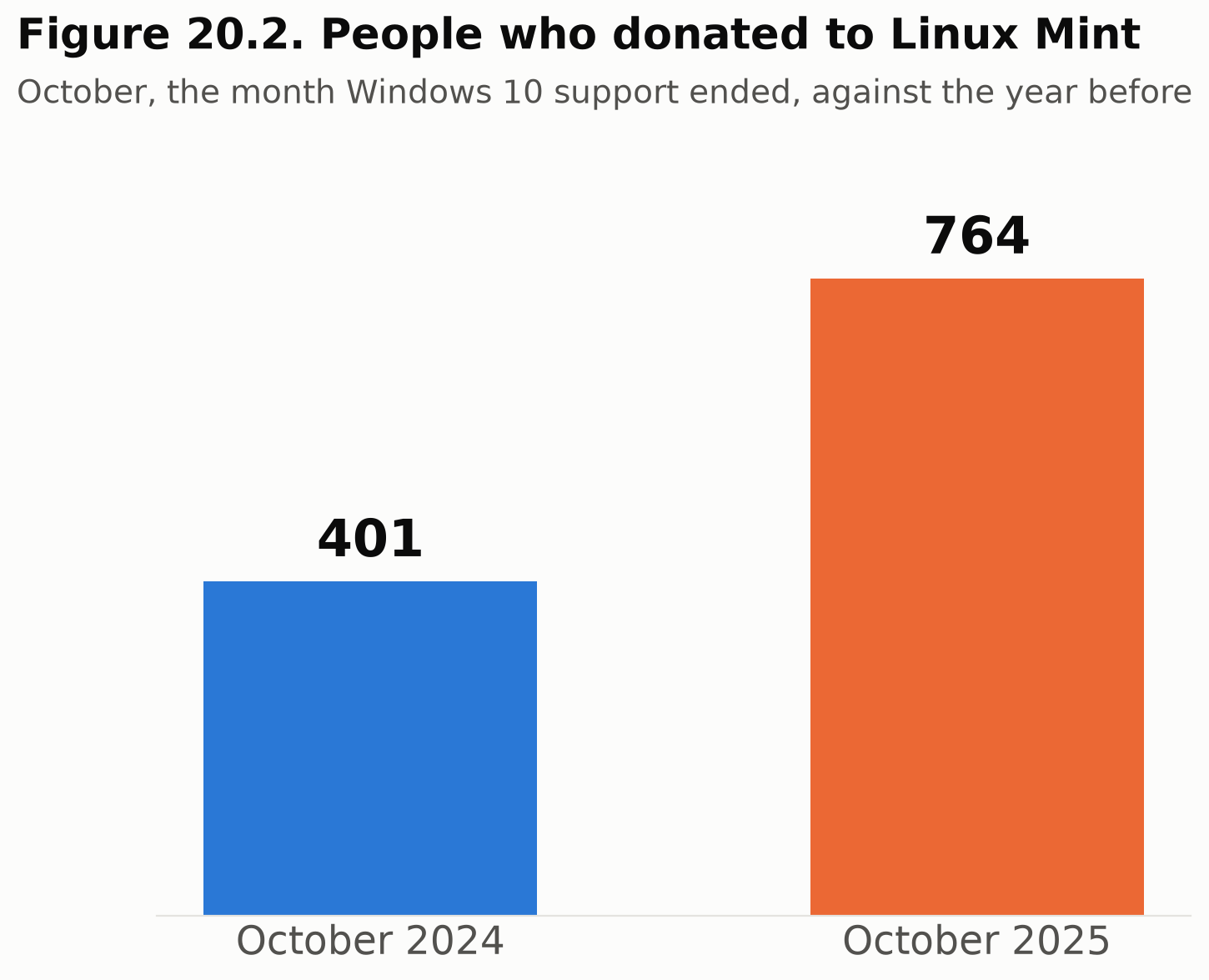
People noticed the way out. Zorin OS 18, a Linux system built to welcome Windows users, came out on October 14, 2025, the day Windows 10 support ended.20.16 In a little over two days it passed 100,000 downloads, and in just over a month it passed one million, with "over 78% of these downloads" coming from Windows computers.20.17 Linux Mint's October donors nearly doubled, from 401 in 2024 to 764 in 2025.20.18 Among Steam's gamers, Linux grew from about 2 percent in mid-2024 to about 3 percent.20.19 Volunteers launched a campaign called End of 10 on May 28, 2025, "bringing Linux to Windows 10 users," with a list of repair cafés and shops ready to help with the switch.20.20 In April 2026, France's government agency for digital services announced its own move to Linux.20.21
Most Windows 10 owners bought new computers or moved to Windows 11, and Linux still runs on a small share of the world's desktops. What changed is that the way out stopped being hard to find.
In 1996, Matthias Ettrich asked strangers to help build a free desktop, and a man who wanted off the vendor's road learned Linux from posts on mailing lists, with no book to guide him.20.22 Thirty years later, the desktop those strangers built runs the computers Windows 11 refuses. And the person holding one of those computers can now hold the book Tom Adelstein didn't have.
Endnotes
2. The want ad
2.1 Matthias Ettrich, "New Project: Kool Desktop Environment. Programmers wanted!," Usenet (comp.os.linux.development.apps, comp.os.linux.misc, de.comp.os.linux.misc), October 14, 1996. https://landley.net/history/mirror/linux/kde-announce.htm ↩
2.2 Matthias Ettrich, "New Project: Kool Desktop Environment. Programmers wanted!," Usenet (comp.os.linux.development.apps, comp.os.linux.misc, de.comp.os.linux.misc), October 14, 1996. https://landley.net/history/mirror/linux/kde-announce.htm ↩
2.3 Matthias Ettrich, "New Project: Kool Desktop Environment. Programmers wanted!," Usenet (comp.os.linux.development.apps, comp.os.linux.misc, de.comp.os.linux.misc), October 14, 1996. https://landley.net/history/mirror/linux/kde-announce.htm ↩
2.4 Matthias Ettrich, "New Project: Kool Desktop Environment. Programmers wanted!," Usenet (comp.os.linux.development.apps, comp.os.linux.misc, de.comp.os.linux.misc), October 14, 1996. https://landley.net/history/mirror/linux/kde-announce.htm ↩
2.5 Robert W. Scheifler, "window system X," email to window@athena, MIT Laboratory for Computer Science, June 19, 1984, as kept in Talisman, "Debut of X." https://www.talisman.org/x-debut.shtml ↩
2.6 Robert W. Scheifler, "X Window System Protocol, Version 11," RFC 1013, Network Working Group, June 1987. https://www.rfc-editor.org/rfc/rfc1013.txt ↩
2.7 Matthias Ettrich, "New Project: Kool Desktop Environment. Programmers wanted!," Usenet (comp.os.linux.development.apps, comp.os.linux.misc, de.comp.os.linux.misc), October 14, 1996. https://landley.net/history/mirror/linux/kde-announce.htm ↩
2.8 The FVWM-95 team, "The FVWM-95 home page," fvwm95.sourceforge.net, n.d. (Wayback Machine copy). http://web.archive.org/web/2005id_/http://fvwm95.sourceforge.net/ ↩
2.9 Matthias Ettrich, "New Project: Kool Desktop Environment. Programmers wanted!," Usenet (comp.os.linux.development.apps, comp.os.linux.misc, de.comp.os.linux.misc), October 14, 1996. https://landley.net/history/mirror/linux/kde-announce.htm ↩
2.10 Matthias Ettrich, "New Project: Kool Desktop Environment. Programmers wanted!," Usenet (comp.os.linux.development.apps, comp.os.linux.misc, de.comp.os.linux.misc), October 14, 1996. https://landley.net/history/mirror/linux/kde-announce.htm ↩
3. The picture that belonged to everyone
3.1 U.S. Court of Appeals for the Ninth Circuit, Apple Computer, Inc. v. Microsoft Corp., 35 F.3d 1435, decided September 19, 1994. https://law.resource.org/pub/us/case/reporter/F3/035/35.F3d.1435.93-16883.93-16869.93-16867.html ↩
3.2 Jeff Johnson, Teresa L. Roberts, William Verplank, David C. Smith, Charles Irby, Marian Beard and Kevin Mackey, "The Xerox 'Star': A Retrospective," IEEE Computer, September 1989 (DigiBarn copy). http://web.archive.org/web/2015id_/http://www.digibarn.com/friends/curbow/star/retrospect/ ↩
3.3 Johnson et al., "The Xerox 'Star': A Retrospective," IEEE Computer, September 1989 (DigiBarn copy). http://web.archive.org/web/2015id_/http://www.digibarn.com/friends/curbow/star/retrospect/ ↩
3.4 Johnson et al., "The Xerox 'Star': A Retrospective," IEEE Computer, September 1989 (DigiBarn copy). http://web.archive.org/web/2015id_/http://www.digibarn.com/friends/curbow/star/retrospect/ ↩
3.5 Johnson et al., "The Xerox 'Star': A Retrospective," IEEE Computer, September 1989 (DigiBarn copy). http://web.archive.org/web/2015id_/http://www.digibarn.com/friends/curbow/star/retrospect/ ↩
3.6 Apple Computer, Inc., press release on Apple v. Microsoft, "Useful info from AppleLink," AppleLink, April 1989. https://savetz.com/ku/ku/applelink_useful_info_from_applelink_april_1989.html ↩
3.7 U.S. Court of Appeals for the Ninth Circuit, Apple Computer, Inc. v. Microsoft Corp., 35 F.3d 1435, decided September 19, 1994. https://law.resource.org/pub/us/case/reporter/F3/035/35.F3d.1435.93-16883.93-16869.93-16867.html ↩
3.8 U.S. Court of Appeals for the Ninth Circuit, Apple Computer, Inc. v. Microsoft Corp., 35 F.3d 1435, decided September 19, 1994. https://law.resource.org/pub/us/case/reporter/F3/035/35.F3d.1435.93-16883.93-16869.93-16867.html ↩
3.9 U.S. District Court for the Northern District of California, Xerox Corp. v. Apple Computer, Inc., 734 F. Supp. 1542, April 10, 1990 (Wayback Machine copy of Justia). http://web.archive.org/web/2023id_/https://law.justia.com/cases/federal/district-courts/FSupp/734/1542/1461830/ ↩
4. The lab that lost its community
4.1 Richard Stallman, "The GNU Project," gnu.org, Free Software Foundation, first published in Open Sources (O'Reilly, 1999), page updated January 20, 2025. https://www.gnu.org/gnu/thegnuproject.en.html ↩
4.2 Richard Stallman, "The GNU Project," gnu.org, Free Software Foundation, first published in Open Sources (O'Reilly, 1999), page updated January 20, 2025. https://www.gnu.org/gnu/thegnuproject.en.html ↩
4.3 Richard Stallman, "The GNU Project," gnu.org, Free Software Foundation, first published in Open Sources (O'Reilly, 1999), page updated January 20, 2025. https://www.gnu.org/gnu/thegnuproject.en.html ↩
4.4 Richard Stallman, "The GNU Project," gnu.org, Free Software Foundation, first published in Open Sources (O'Reilly, 1999), page updated January 20, 2025. https://www.gnu.org/gnu/thegnuproject.en.html ↩
4.5 Richard Stallman, "The GNU Project," gnu.org, Free Software Foundation, first published in Open Sources (O'Reilly, 1999), page updated January 20, 2025. https://www.gnu.org/gnu/thegnuproject.en.html ↩
4.6 Richard Stallman, "new Unix implementation" (the initial announcement of GNU), Usenet (net.unix-wizards, net.usoft), September 27, 1983, as kept at gnu.org. https://www.gnu.org/gnu/initial-announcement.en.html ↩
4.7 Richard Stallman, "new Unix implementation" (the initial announcement of GNU), Usenet (net.unix-wizards, net.usoft), September 27, 1983, as kept at gnu.org. https://www.gnu.org/gnu/initial-announcement.en.html ↩
4.8 Richard Stallman, "The GNU Project," gnu.org, Free Software Foundation, first published in Open Sources (O'Reilly, 1999), page updated January 20, 2025. https://www.gnu.org/gnu/thegnuproject.en.html ↩
4.9 Richard Stallman, "The GNU Project," gnu.org, Free Software Foundation, first published in Open Sources (O'Reilly, 1999), page updated January 20, 2025. https://www.gnu.org/gnu/thegnuproject.en.html ↩
4.10 Richard Stallman, "The GNU Project," gnu.org, Free Software Foundation, first published in Open Sources (O'Reilly, 1999), page updated January 20, 2025. https://www.gnu.org/gnu/thegnuproject.en.html ↩
4.11 Richard Stallman, "The GNU Project," gnu.org, Free Software Foundation, first published in Open Sources (O'Reilly, 1999), page updated January 20, 2025. https://www.gnu.org/gnu/thegnuproject.en.html ↩
4.12 Richard Stallman, "The GNU Project," gnu.org, Free Software Foundation, first published in Open Sources (O'Reilly, 1999), page updated January 20, 2025. https://www.gnu.org/gnu/thegnuproject.en.html ↩
4.13 Richard Stallman, "The GNU Project," gnu.org, Free Software Foundation, first published in Open Sources (O'Reilly, 1999), page updated January 20, 2025. https://www.gnu.org/gnu/thegnuproject.en.html ↩
4.14 Richard Stallman, "The GNU Project," gnu.org, Free Software Foundation, first published in Open Sources (O'Reilly, 1999), page updated January 20, 2025. https://www.gnu.org/gnu/thegnuproject.en.html ↩
4.15 Richard Stallman, "The GNU Project," gnu.org, Free Software Foundation, first published in Open Sources (O'Reilly, 1999), page updated January 20, 2025. https://www.gnu.org/gnu/thegnuproject.en.html ↩
4.16 Richard Stallman, "The GNU Project," gnu.org, Free Software Foundation, first published in Open Sources (O'Reilly, 1999), page updated January 20, 2025. https://www.gnu.org/gnu/thegnuproject.en.html ↩
4.17 Richard Stallman, "new Unix implementation" (the initial announcement of GNU), Usenet (net.unix-wizards, net.usoft), September 27, 1983, as kept at gnu.org (https://www.gnu.org/gnu/initial-announcement.en.html); and Stallman, "The GNU Project," gnu.org, Free Software Foundation, first published in Open Sources (O'Reilly, 1999), page updated January 20, 2025. https://www.gnu.org/gnu/thegnuproject.en.html ↩
5. The machine underneath
5.1 Linus Torvalds, "What would you like to see most in minix?," Usenet (comp.os.minix), August 25, 1991, in "LINUX's History by Linus Torvalds," July 31, 1992, Carnegie Mellon University copy. https://www.cs.cmu.edu/~awb/linux.history.html ↩
5.2 Linus Torvalds, "What would you like to see most in minix?," Usenet (comp.os.minix), August 25, 1991, in "LINUX's History by Linus Torvalds," July 31, 1992, Carnegie Mellon University copy. https://www.cs.cmu.edu/~awb/linux.history.html ↩
5.3 Linus Torvalds, "What would you like to see most in minix?," Usenet (comp.os.minix), August 25, 1991, in "LINUX's History by Linus Torvalds," July 31, 1992, Carnegie Mellon University copy. https://www.cs.cmu.edu/~awb/linux.history.html ↩
5.4 Richard Stallman, "GNU/Linux FAQ," gnu.org, Free Software Foundation, page updated October 27, 2025. https://www.gnu.org/gnu/gnu-linux-faq.en.html ↩
5.5 Andrew S. Tanenbaum, "LINUX is obsolete," Usenet (comp.os.minix), January 29, 1992, in Open Sources: Voices from the Open Source Revolution (O'Reilly, January 1999), Appendix A, "The Tanenbaum-Torvalds Debate." https://www.oreilly.com/openbook/opensources/book/appa.html ↩
5.6 Andrew S. Tanenbaum, "LINUX is obsolete," Usenet (comp.os.minix), January 29, 1992, in Open Sources: Voices from the Open Source Revolution (O'Reilly, January 1999), Appendix A, "The Tanenbaum-Torvalds Debate." https://www.oreilly.com/openbook/opensources/book/appa.html ↩
5.7 Andrew S. Tanenbaum, "LINUX is obsolete," Usenet (comp.os.minix), January 29, 1992, in Open Sources: Voices from the Open Source Revolution (O'Reilly, January 1999), Appendix A, "The Tanenbaum-Torvalds Debate." https://www.oreilly.com/openbook/opensources/book/appa.html ↩
5.8 Linus Torvalds, "Re: LINUX is obsolete," Usenet (comp.os.minix), January 29, 1992, in Open Sources: Voices from the Open Source Revolution (O'Reilly, January 1999), Appendix A, "The Tanenbaum-Torvalds Debate." https://www.oreilly.com/openbook/opensources/book/appa.html ↩
5.9 Linus Torvalds, "Apologies (was Re: LINUX is obsolete)," Usenet (comp.os.minix), January 30, 1992, in Open Sources: Voices from the Open Source Revolution (O'Reilly, January 1999), Appendix A, "The Tanenbaum-Torvalds Debate." https://www.oreilly.com/openbook/opensources/book/appa.html ↩
5.10 Linus Torvalds, "Release Notes for Linux v0.12," kernel.org, n.d. https://www.kernel.org/pub/linux/kernel/Historic/old-versions/RELNOTES-0.12 ↩
5.11 kernel.org, directory listing for Linux v1.0, tarball dated March 13, 1994 (https://cdn.kernel.org/pub/linux/kernel/v1.0/); line count of the .c, .h, .S and .s files in linux-1.0.tar.gz, 170,581 lines, counted October 23, 2026. https://cdn.kernel.org/pub/linux/kernel/v1.0/linux-1.0.tar.gz ↩
5.12 Linus Torvalds and contributors, CREDITS file, Linux 1.0 source tree, March 1994 (80 N: entries). https://cdn.kernel.org/pub/linux/kernel/v1.0/linux-1.0.tar.gz ↩
6. The room Linux walked into
6.1 Michael Slater, "SuperSPARC Premiers in SPARCstation 10," Microprocessor Report, May 27, 1992. https://www.ardent-tool.com/CPU/docs/MPR/19920527/060702.pdf ↩
6.2 SGIstuff, "Indy / Challenge S," sgistuff.net (irixnet archive), n.d., price history entry for July 1993. https://archive.irixnet.org/sgistuff/hardware/systems/indy.html ↩
6.3 Gateway 2000, "Family PCs" advertisement (4DX2-66 Family PC, $1,599), PC Computing, February 1995, scanned text at the Internet Archive. https://archive.org/stream/pc-computing-magazine-v8i2/pc-computing-magazine-v8i2_djvu.txt ↩
6.4 Donnalyn Frey, "UNIX vs. UNIX," Dr. Dobb's Journal, December 1988. https://jacobfilipp.com/DrDobbs/articles/DDJ/1988/8812/8812b/8812b.htm ↩
6.5 Open Software Foundation founding press release, New York, May 17, 1988, posted to Usenet (comp.unix.wizards) as "Open Software Foundation," May 1988. https://www.tuhs.org/Usenet/comp.unix.wizards/1988-May/032582.html ↩
6.6 CBR Staff Writer, "Sun Accuses HP of 'Oppose Java Forever' Mentality," Computer Business Review (now Tech Monitor), December 8, 1998. https://www.techmonitor.ai/technology/sun_accuses_hp_of_oppose_java_forever_mentality ↩
6.7 Unix System Laboratories, Inc. v. Berkeley Software Design, Inc., Complaint, Civil Action No. 92-1667 (D.N.J.), April 1992 (TUHS archive file 920420). https://minnie.tuhs.org/Mirrors/USLvsUCB/920420.complaint ↩
6.8 Unix System Laboratories, Inc. v. Berkeley Software Design, Inc. and the Regents of the University of California, First Amended Complaint, Civil Action No. 92-1667 (D.N.J.), July 24, 1992. https://minnie.tuhs.org/Mirrors/USLvsUCB/920724.complaint ↩
6.9 Rob Kolstad, Berkeley Software Design, "USL vs. BSDI Lawsuit Settled," Usenet (comp.os.386bsd.announce and others), February 6, 1994. http://cdn.netbsd.org/pub/NetBSD/misc/release/misc/USL-lawsuit ↩
6.10 Marshall Kirk McKusick, "Twenty Years of Berkeley Unix: From AT&T-Owned to Freely Redistributable," Open Sources: Voices from the Open Source Revolution (O'Reilly, January 1999). https://www.oreilly.com/openbook/opensources/book/kirkmck.html ↩
6.11 Mike Linksvayer, "Linus Torvalds Interview," Meta magazine, November 1993. http://gondwanaland.com/meta/history/interview.html ↩
6.12 Mike Linksvayer, "Linus Torvalds Interview," Meta magazine, November 1993. http://gondwanaland.com/meta/history/interview.html ↩
7. The Unix that took the desktop
7.1 Don Reisinger, "Steve Jobs Sold NeXT to Apple 20 Years Ago," Fortune, December 20, 2016 (https://fortune.com/2016/12/20/apple-next-anniversary/); and MIT Project Athena, "Details on NEXT workstation," staff mail carrying Ted Hanss's report on the NeXT launch of October 12, 1988, October 13, 1988. https://stuff.mit.edu/afs/net/user/tytso/archive/next.machine ↩
7.2 MIT Project Athena, "Details on NEXT workstation," staff mail carrying Ted Hanss's report on the NeXT launch of October 12, 1988, October 13, 1988. https://stuff.mit.edu/afs/net/user/tytso/archive/next.machine ↩
7.3 MIT Project Athena, "Details on NEXT workstation," staff mail carrying Ted Hanss's report on the NeXT launch of October 12, 1988, October 13, 1988. https://stuff.mit.edu/afs/net/user/tytso/archive/next.machine ↩
7.4 MIT Project Athena, "Details on NEXT workstation," staff mail carrying Ted Hanss's report on the NeXT launch of October 12, 1988, October 13, 1988. https://stuff.mit.edu/afs/net/user/tytso/archive/next.machine ↩
7.5 Tim Berners-Lee, "WorldWideWeb, the first Web client," w3.org, n.d. https://www.w3.org/People/Berners-Lee/WorldWideWeb.html ↩
7.6 CERN, "A short history of the Web," home.cern, n.d. (Wayback Machine copy). https://web.archive.org/web/2023/https://home.cern/science/computing/birth-web/short-history-web ↩
7.7 Los Angeles Times, "Sweeping Layoffs Expected at Apple," February 1, 1997. https://www.latimes.com/archives/la-xpm-1997-02-01-fi-24309-story.html ↩
7.8 Apple Computer, Inc., "Apple Computer, Inc. Agrees to Acquire NeXT Software Inc.," press release, December 20, 1996 (MacTech reprint). https://www.mactech.com/1996/12/21/md1-apple-acquires-next-software/ ↩
7.9 Apple Computer, Inc., Form 10-Q for the quarter ended June 27, 1997, Note 3, filed with the SEC August 11, 1997. https://www.sec.gov/Archives/edgar/data/0000320193/000032019397000014/0000320193-97-000014.txt ↩
7.10 Apple Computer, Inc., "Mac OS X Server Embraces Open Source With Launch of Darwin," press release, March 16, 1999 (MacTech reprint). https://www.mactech.com/1999/03/16/md1-mac-os-x-server-embraces-open-source-with-launch-of-darwin/ ↩
7.11 Apple Inc., "What is XNU?," README, XNU source repository, apple-oss-distributions, n.d. https://raw.githubusercontent.com/apple-oss-distributions/xnu/main/README.md ↩
7.12 Apple Computer, Inc., "Mac OS X Hits Stores This Weekend," press release, March 21, 2001. https://www.apple.com/newsroom/2001/03/21Mac-OS-X-Hits-Stores-This-Weekend/ ↩
7.13 The Open Group, Register of Open Branded Products, entry for Mac OS X Version 10.5 Leopard on Intel-based Macintosh computers, "Registered on: 18-May-2007" (Wayback Machine copy, 2008). http://web.archive.org/web/2008id_/http://www.opengroup.org/openbrand/register/brand3555.htm ↩
7.14 The Open Group, Open Brand register, Apple Inc. products (macOS 15.0 Sequoia and macOS 26.0 Tahoe, UNIX 03), accessed October 23, 2026. https://www.opengroup.org/openbrand/register/apple.htm ↩
7.15 Microsoft Corp., "Microsoft and Apple Affirm Commitment to Build Next Generation Software for Macintosh," press release, Boston, August 6, 1997. https://news.microsoft.com/1997/08/06/microsoft-and-apple-affirm-commitment-to-build-next-generation-software-for-macintosh/ ↩
8. A desktop for the people who built it
8.1 The Linux Documentation Project, "Modem-HOWTO: Modems for a Linux PC," chapter 2, tldp.org, n.d. (text dated late 2001). https://tldp.org/HOWTO/Modem-HOWTO-2.html ↩
8.2 Michael Scott Shappe, "WordPerfect 8 for Linux," Linux Journal, June 1, 1999. https://www.linuxjournal.com/article/3046 ↩
8.3 Fred Butzen, "Applixware and StarOffice," Linux Journal, October 1, 1998 (price with Red Hat 5.1). https://www.linuxjournal.com/article/3080 ↩
8.4 Jason Kroll, "Office Wars: Applixware and StarOffice," Linux Journal, February 1, 2000 (https://www.linuxjournal.com/article/3791); and Charles Stross, "Office Applications round-up," Computer Shopper Linux column 143, 1999 (Wayback Machine copy). https://web.archive.org/web/2020id_/http://www.antipope.org/charlie/old/linux/shopper/143-office-soft.html ↩
8.5 GIMP team, "A Brief (and Ancient) History of GIMP," gimp.org, written around the release of GIMP 1.0 in 1998 (https://www.gimp.org/about/ancient_history.html); and GIMP team, "How It All Started," gimp.org, n.d. (Peter Mattis's posts of July 1995). https://www.gimp.org/about/prehistory.html ↩
8.6 GIMP team, "A Brief (and Ancient) History of GIMP," gimp.org, written around the release of GIMP 1.0 in 1998. https://www.gimp.org/about/ancient_history.html ↩
8.7 Zachary Beane, "GIMP Gazette Profile: Spencer Kimball and Peter Mattis," GIMP Gazette, January 1, 1997. URL not recorded in the research folder; saved copy research/14-grok-bot-sources/gimp-gazette-1997-01.html. ↩
8.8 Dennis E. Powell, "Founder, Creditors Differ as to Loki's Future Course," Linux Today, August 17, 2001 (https://www.linuxtoday.com/it-management/founder-creditors-differ-as-to-lokis-future-course/); and "LinuxGames.com: Loki's Details on Closing Down," Linux Today, January 31, 2002. https://www.linuxtoday.com/it-management/linuxgames-com-lokis-details-on-closing-down/ ↩
8.9 Tom Adelstein, introduction (unpublished draft), Introduction-toms.docx: "After finding posts people made in mailing lists, I found ways to execute commands." ↩
9. Beowulf: sixteen PCs on a bench
9.1 CESDIS (NASA Goddard Space Flight Center), "Introduction to the CESDIS Beowulf Project," Duke University mirror, n.d. https://webhome.phy.duke.edu/~rgb/brahma/Resources/beowulf/intro.html ↩
9.2 Phil Merkey, "Beowulf History," beowulf.org, n.d. https://www.beowulf.org/overview/history.html ↩
9.3 Donald J. Becker, Thomas Sterling et al., "BEOWULF: A Parallel Workstation for Scientific Computation," Proceedings of the International Conference on Parallel Processing (ICPP), 1995. https://webhome.phy.duke.edu/~rgb/brahma/Resources/beowulf/papers/ICPP95/icpp95.html ↩
9.4 Phil Merkey, "Beowulf History," beowulf.org, n.d. https://www.beowulf.org/overview/history.html ↩
9.5 Linux kernel documentation, "Linux Ethernet Bonding Driver HOWTO," docs.kernel.org, n.d. https://docs.kernel.org/networking/bonding.html ↩
9.6 Linux kernel, CREDITS file, entry for Donald Becker, torvalds/linux repository (GitHub mirror), n.d. https://raw.githubusercontent.com/torvalds/linux/master/CREDITS ↩
9.7 Phil Merkey, "Beowulf History," beowulf.org, n.d. https://www.beowulf.org/overview/history.html ↩
9.8 Chris Lawrence, "Linux/m68k: Linux on Motorola's 68000 Processor," Linux Journal, 1 May 1997. https://www.linuxjournal.com/article/2090 ↩
9.9 Jim Paradis, "Porting Linux to the DEC Alpha: The Kernel and Shell," Linux Journal, 1 Dec 1995. https://www.linuxjournal.com/article/1178 ↩
9.10 USENIX, conference summary of David S. Miller and Miguel de Icaza, "The SPARC Port of Linux," USENIX 1997 Annual Technical Conference, 1997. https://www.usenix.org/legacy/publications/library/proceedings/ana97/summaries/miller_invite.html ↩
9.11 Sun Microsystems, Form 10-K for the fiscal year ended 30 June 2001, SEC EDGAR, 2001. https://www.sec.gov/Archives/edgar/data/709519/000091205701532905/0000912057-01-532905.txt; Sun Microsystems, Form 10-K for the fiscal year ended 30 June 2005, SEC EDGAR, 2005. https://www.sec.gov/Archives/edgar/data/709519/000119312505184847/0001193125-05-184847.txt ↩
9.12 Oracle, "Oracle Buys Sun," press release, 20 Apr 2009. https://www.oracle.com/corporate/pressrelease/oracle-buys-sun-042009.html; Oracle, "Oracle Completes Acquisition of Sun," press release (SEC exhibit 99.1), 27 Jan 2010. https://www.sec.gov/Archives/edgar/data/1341439/000119312510015241/dex991.htm ↩
9.13 Silicon Graphics, Form 10-K for fiscal 1997, SEC EDGAR, 1997. https://www.sec.gov/Archives/edgar/data/802301/0000912057-97-032025.txt; Silicon Graphics, Form 10-K for fiscal 2006 (Chapter 11 petition of 8 May 2006), SEC EDGAR, 2006. https://www.sec.gov/Archives/edgar/data/802301/000119312506208370/d10k.htm; InfoWorld, "Rackable Systems becomes SGI, closes deal," 11 May 2009. https://www.infoworld.com/article/2632392/rackable-systems-becomes-sgi--closes-deal.html ↩
9.14 Erick Schonfeld, "Silicon Graphics Declares Bankruptcy and Sells Itself For $25 Million," TechCrunch, 1 Apr 2009. https://techcrunch.com/2009/04/01/silicon-graphics-declares-bankruptcy-and-sold-for-25-million/ ↩
10. The one owned thing
10.1 Matthias Ettrich, "New Project: Kool Desktop Environment (KDE)," Usenet post of 14 Oct 1996, KDE copy, kde.org. https://kde.org/announcements/announcement/ ↩
10.2 Troll Tech, "Qt Free Edition to go Open Source," announcement of 1998, reposted to a mailing list 26 Jan 1999. https://linux2.mathematik.tu-darmstadt.de/pub/linux/distributions/old/mulinux/archive/0275.html ↩
10.3 GIMP, "How It All Started" (Peter Mattis, "ANNOUNCE: The GIMP," 21 Nov 1995), gimp.org. https://www.gimp.org/about/prehistory.html; GIMP, "A Brief (and Ancient) History of GIMP," gimp.org. https://www.gimp.org/about/ancient_history.html ↩
10.4 GIMP, "A Brief (and Ancient) History of GIMP," gimp.org. https://www.gimp.org/about/ancient_history.html ↩
10.5 Zachary Beane, "GIMP Gazette Profile: Spencer Kimball and Peter Mattis" (answers written mostly by Mattis), GIMP Gazette, 1 Jan 1997. Saved copy; URL not recorded. ↩
10.6 Miguel de Icaza, "The GNOME Desktop project," gtk-list, 15 Aug 1997. https://mail.gnome.org/archives/gtk-list/1997-August/msg00123.html ↩
10.7 Miguel de Icaza, "The GNOME Desktop project," gtk-list, 15 Aug 1997. https://mail.gnome.org/archives/gtk-list/1997-August/msg00123.html ↩
10.8 Richard Stallman, "The GNU Project," gnu.org. https://www.gnu.org/gnu/thegnuproject.en.html ↩
10.9 Richard Stallman, "The GNU Project," gnu.org. https://www.gnu.org/gnu/thegnuproject.en.html; Troll Tech, "Qt Free Edition to go Open Source," announcement of 1998, reposted 26 Jan 1999. https://linux2.mathematik.tu-darmstadt.de/pub/linux/distributions/old/mulinux/archive/0275.html ↩
10.10 LWN.net, Weekly Edition, 7 Sep 2000. https://lwn.net/2000/0907/ ↩
10.11 KDE.news, "Qt, now also GPL!" 5 Sep 2000. https://dot.kde.org/2000/09/05/qt-now-also-gpl/ ↩
10.12 Richard Stallman, "Stallman on Qt, the GPL, KDE, and GNOME," Linux Today, 5 Sep 2000. https://www.linuxtoday.com/developer/stallman-on-qt-the-gpl-kde-and-gnome/ ↩
10.13 KDE, "KDE Official Response to Stallman Editorial," kde.org, 5 Sep 2000. https://kde.org/announcements/rmsresponse/ ↩
10.14 Matthias Ettrich, "New Project: Kool Desktop Environment (KDE)," Usenet post of 14 Oct 1996, KDE copy, kde.org. https://kde.org/announcements/announcement/; LWN.net, Weekly Edition, 7 Sep 2000. https://lwn.net/2000/0907/ ↩
11. The applications decide
11.1 David Weisberg, "Parametric Technology Corporation," History of CAD, Shapr3D, 27 Mar 2023. https://www.shapr3d.com/history-of-cad/parametric-technology-corporation ↩
11.2 David Weisberg, "Parametric Technology Corporation," History of CAD, Shapr3D, 27 Mar 2023. https://www.shapr3d.com/history-of-cad/parametric-technology-corporation ↩
11.3 Intergraph Corporation, Form 10-K405 for fiscal 1996, SEC EDGAR, 1997. https://www.sec.gov/Archives/edgar/data/351145/000035114597000001/0000351145-97-000001.txt ↩
11.4 Microsoft and Dassault Systèmes, "Microsoft and Dassault Systemes Cooperate to Deliver," press release on CATIA Version 5 for Windows NT, 12 Oct 1998. https://news.microsoft.com/1998/10/12/microsoft-and-dassault-systemes-cooperate-to-deliver-2/ ↩
11.5 HPCwire, "SGI Intros New Line of Intel-Based Workstations," 15 Jan 1999 (Wayback copy). https://web.archive.org/web/2020id_/https://www.hpcwire.com/1999/01/15/sgi-intros-new-line-intel-based-workstations/ ↩
11.6 CBR staff writer, "IDC Says Unix Is Still Dominant, but NT Looming Large," Computer Business Review (Tech Monitor), 11 Jul 1999 (Wayback copy). https://web.archive.org/web/2020id_/https://www.techmonitor.ai/technology/idc_says_unix_is_still_dominant_but_nt_looming_large ↩
11.7 Red Hat, "Red Hat Enterprise Linux Chosen for Electronic Design Automation," press release, 17 Feb 2004. https://www.redhat.com/en/about/press-releases/press-electronicdesign ↩
11.8 Linux Today, reposting CNET News.com, "IBM to spend $1 billion on Linux in 2001," December 12, 2000. https://www.linuxtoday.com/high-performance/cnet-news-com-ibm-to-spend-1-billion-on-linux-in-2001/ ↩
11.9 Tom Adelstein, "Understanding and Replacing Microsoft Exchange," Linux Journal, February 1, 2003. ↩
11.10 Donald K. Rosenberg, "Bynari Finds Missing Link," Linux Line, IBM, April 2002 (Wayback Machine capture of June 5, 2002). https://web.archive.org/web/20020605231728/http://www-1.ibm.com:80/linux/linuxline/apr02/partnernews.shtml ↩
11.11 Tom Adelstein, "Understanding and Replacing Microsoft Exchange," Linux Journal, 1 Feb 2003. https://www.linuxjournal.com/article/6368 ↩
11.12 Ian Peter, "The Browser Wars," History of the Internet, nethistory.info. https://www.nethistory.info/History%20of%20the%20Internet/browserwars.html ↩
11.13 Mitchell Baker, "Mozilla Turns Twenty," Mozilla blog, 31 Mar 2018. https://blog.mozilla.org/en/mozilla/mozilla-turns-twenty/ ↩
11.14 U.S. District Court for the District of Columbia, United States v. Microsoft Corp., Court's Findings of Fact, Judge Thomas Penfield Jackson, 5 Nov 1999, U.S. Department of Justice. https://www.justice.gov/atr/us-v-microsoft-courts-findings-fact ↩
12. The hinge: Red Hat takes the backend
12.1 Tom Adelstein, conversation with the editor, 23 Oct 2026. ↩
12.2 Andrew Leonard, "Red Hot," Salon, 12 Aug 1999 (IPO "on Wednesday," 11 Aug). https://www.salon.com/1999/08/12/redhat_ipo/; Red Hat, "Red Hat Plans to List Shares on the New York Stock Exchange," press release, 17 Nov 2006. https://www.redhat.com/en/about/press-releases/nyse ↩
12.3 Andrew Leonard, "Red Hot," Salon, 12 Aug 1999. https://www.salon.com/1999/08/12/redhat_ipo/ ↩
12.4 Red Hat, "Technology Industry Leaders Commit Enterprise Support for Red Hat Linux Advanced Server," press release, 26 Mar 2002. https://www.redhat.com/en/about/press-releases/press-advancedserversupport ↩
12.5 LWN.net, "The new Fedora project," Weekly Edition, 25 Sep 2003. https://lwn.net/Articles/49963/ ↩
12.6 LWN.net, "The new Fedora project," Weekly Edition, 25 Sep 2003. https://lwn.net/Articles/49963/; Red Hat, "Fedora Project and Red Hat Deliver New Linux Platform to Open Source Community," press release, 6 Nov 2003. https://www.redhat.com/en/about/press-releases/press-fedora ↩
12.7 LWN.net, "Red Hat Linux ends - now what?" Nov 2003. https://lwn.net/Articles/56947/ ↩
12.8 OSnews, "Red Hat's Plans on the Desktop," 17 Apr 2008. https://www.osnews.com/story/19647/red-hats-plans-on-the-desktop/; John Ribeiro, "Red Hat skips consumer Linux desktop," InfoWorld, 17 Apr 2008 (blog post "Wednesday," 16 Apr). https://www.infoworld.com/article/2334282/red-hat-skips-consumer-linux-desktop-2.html ↩
12.9 The Register, "Red Hat scurries away from consumer desktop market," 17 Apr 2008. https://www.theregister.com/2008/04/17/red_hat_abandons_consumer_desktop_market/ ↩
12.10 TOP500.org, "Operating System Family / Linux," list statistics (June 2017: 498; November 2017: 500). https://www.top500.org/statistics/details/osfam/1/ ↩
12.11 IBM and Red Hat, "IBM to Acquire Red Hat, Completely Changing the Cloud Landscape and Becoming World's #1 Hybrid Cloud Provider," press release, 28 Oct 2018. https://www.redhat.com/zh-cn/about/press-releases/ibm-acquire-red-hat-completely-changing-cloud-landscape-and-becoming-worlds-1-hybrid-cloud-provider ↩
12.12 IBM and Red Hat, "IBM Closes Landmark Acquisition of Red Hat for $34 Billion; Defines Open, Hybrid Cloud Future," press release, 9 Jul 2019. https://www.redhat.com/en/about/press-releases/ibm-closes-landmark-acquisition-red-hat-34-billion-defines-open-hybrid-cloud-future ↩
13. Linux for human beings
13.1 VeriSign, Form 8-K on the proposed acquisition of Thawte Consulting (agreement of 19 Dec 1999), SEC EDGAR, 2000. https://www.sec.gov/Archives/edgar/data/0001014473/000101287000000044/0001012870-00-000044.txt ↩
13.2 Steven Liversedge, "VeriSign Buys South Africa's Thawte for $575 Million," InternetNews, 23 Dec 1999. https://internetnews.com/it-management/verisign-buys-south-africas-thawte-for-575-million ↩
13.3 European Space Agency, "Soyuz Taxi crewmembers," image caption, esa.int, 2 May 2002. https://www.esa.int/ESA_Multimedia/Images/2002/05/Soyuz_Taxi_crewmembers ↩
13.4 Canonical, "About the Ubuntu project," ubuntu.com. https://ubuntu.com/about; Mark Shuttleworth, "Announcing Ubuntu 4.10 'The Warty Warthog Release'," ubuntu-announce, 20 Oct 2004. https://lists.ubuntu.com/archives/ubuntu-announce/2004-October/000003.html ↩
13.5 Mark Shuttleworth, "Announcing Ubuntu 4.10 'The Warty Warthog Release'," ubuntu-announce, 20 Oct 2004. https://lists.ubuntu.com/archives/ubuntu-announce/2004-October/000003.html ↩
13.6 Jono Bacon, "Refreshing The Ubuntu Brand," Linux.com, 4 Mar 2010. https://www.linux.com/news/refreshing-ubuntu-brand/ ↩
13.7 Launchpad, Ubuntu Bug #1, "Microsoft has a majority market share," reported by Mark Shuttleworth, 20 Aug 2004. https://bugs.launchpad.net/ubuntu/+bug/1 ↩
13.8 Launchpad, Ubuntu Bug #1, "Microsoft has a majority market share," reported by Mark Shuttleworth, 20 Aug 2004. https://bugs.launchpad.net/ubuntu/+bug/1 ↩
13.9 Launchpad, Ubuntu Bug #1, reported 20 Aug 2004. https://bugs.launchpad.net/ubuntu/+bug/1; Mark Shuttleworth, Comment #1834 on Bug #1, Launchpad, 30 May 2013. https://bugs.launchpad.net/ubuntu/+bug/1/comments/1834 ↩
13.10 Mark Shuttleworth, "Announcing Ubuntu 4.10 'The Warty Warthog Release'," ubuntu-announce, 20 Oct 2004. https://lists.ubuntu.com/archives/ubuntu-announce/2004-October/000003.html ↩
13.11 Canonical, "ShipIt comes to an end," Canonical blog, 5 Apr 2011. https://canonical.com/blog/shipit-comes-to-an-end ↩
13.12 Linux Mint, "About Linux Mint," linuxmint.com. https://linuxmint.com/about.php ↩
13.13 Linux Mint, "About Linux Mint," linuxmint.com. https://linuxmint.com/about.php ↩
13.14 Mark Shuttleworth, "Growing Ubuntu for cloud and IoT, rather than phone and convergence," Ubuntu blog, 5 Apr 2017. https://ubuntu.com/blog/growing-ubuntu-for-cloud-and-iot-rather-than-phone-and-convergence ↩
13.15 Mark Shuttleworth, Comment #1834 on Bug #1, Launchpad, 30 May 2013. https://bugs.launchpad.net/ubuntu/+bug/1/comments/1834 ↩
14. Building the plumbing
14.1 Havoc Pennington, "X desktop group," email to LWN, 25 Apr 2000. https://static.lwn.net/2000/0427/a/freedesktop.html ↩
14.2 Fedora Project Wiki, "NetworkManager in Fedora 13," c. 2010. https://fedoraproject.org/wiki/NetworkManager_in_Fedora_13; NetworkManager repository, earliest commits (Dan Williams, dcbw@redhat.com, 24 Jun 2004), gitlab.freedesktop.org. https://gitlab.freedesktop.org/api/v4/projects/NetworkManager%2FNetworkManager/repository/commits?until=2004-07-06T00:00:00Z&per_page=100 ↩
14.3 PulseAudio repository, earliest commits (Lennart Poettering, 8 Jun 2004), gitlab.freedesktop.org. https://gitlab.freedesktop.org/api/v4/projects/pulseaudio%2Fpulseaudio/repository/commits?until=2004-07-15T00:00:00Z&per_page=100 ↩
14.4 Wayland repository, earliest commits (Kristian Høgsberg, 30 Sep 2008), gitlab.freedesktop.org. https://gitlab.freedesktop.org/api/v4/projects/wayland%2Fwayland/repository/commits?until=2008-10-15T00:00:00Z&per_page=100; Robert W. Scheifler, "window system X," message to window@athena, MIT, 19 Jun 1984. https://www.talisman.org/x-debut.shtml ↩
14.5 James Maguire, "The SourceForge Story," Datamation. https://www.datamation.com/open-source/the-sourceforge-story/ ↩
14.6 LWN.net, "The kernel and BitKeeper part ways," 6 Apr 2005. https://lwn.net/Articles/130746/ ↩
14.7 Taylor Blau, "Git turns 20: A Q&A with Linus Torvalds," The GitHub Blog, 2025. https://github.blog/open-source/git/git-turns-20-a-qa-with-linus-torvalds/ ↩
14.8 Chris Wanstrath, "We Launched," The GitHub Blog, 10 Apr 2008. https://github.blog/news-insights/the-library/we-launched/ ↩
14.9 Microsoft, "Microsoft to acquire GitHub for $7.5 billion," press release, 4 Jun 2018. https://news.microsoft.com/source/2018/06/04/microsoft-to-acquire-github-for-7-5-billion/ ↩
14.10 Linux kernel documentation, "Submitting patches," docs.kernel.org. https://docs.kernel.org/process/submitting-patches.html ↩
14.11 Lennart Poettering, "Rethinking PID 1," 0pointer.de, 30 Apr 2010. http://0pointer.de/blog/projects/systemd.html ↩
14.12 Bdale Garbee, "Bug#727708: call for votes on default Linux init system for jessie," debian-ctte mailing list, 11 Feb 2014 (Wayback copy). https://web.archive.org/web/2020id_/https://lists.debian.org/debian-ctte/2014/02/msg00405.html ↩
14.13 Devuan, "Announcement of the Debian Fork," devuan.org, 27 Nov 2014. https://www.devuan.org/os/announce/ ↩
14.14 Linux Foundation, "Linux Kernel Report: More Contributors Than Ever," Linux Foundation blog, 18 Feb 2015. https://www.linuxfoundation.org/blog/blog/linux-kernel-report-more-contributors-than-ever ↩
14.15 Red Hat e-mail addresses in the record: Havoc Pennington (hp@redhat.com), "X desktop group," 25 Apr 2000, https://static.lwn.net/2000/0427/a/freedesktop.html; Dan Williams (dcbw@redhat.com) and Kristian Høgsberg (krh@redhat.com), first commits to NetworkManager (2004) and Wayland (2008), gitlab.freedesktop.org. ↩
15. Designers decide for the user
15.1 GSA, "IT Accessibility Laws and Policies," Section508.gov, accessed 23 Oct 2026. https://www.section508.gov/manage/laws-and-policies/ ; Architectural and Transportation Barriers Compliance Board, "Electronic and Information Technology Accessibility Standards," final rule, 65 FR 80500, Federal Register, 21 Dec 2000 (effective 20 Feb 2001). https://www.federalregister.gov/documents/2000/12/21/00-32017/electronic-and-information-technology-accessibility-standards ↩
15.2 Havoc Pennington, "Free software UI," ometer.com, April 2002. https://ometer.com/free-software-ui.html ↩
15.3 Sun Microsystems, "Overview of Accessibility," GNOME 2.0 Desktop for the Solaris Operating Environment Accessibility Guide, ch. 1. https://docs.oracle.com/cd/E19754-01/816-7282/accessintro-2/index.html ↩
15.4 Janina Sajka, "looking for VoIP software, console," Blinux-list, 21 Jun 2004 (Wayback copy). https://web.archive.org/web/2024/https://listman.redhat.com/archives/blinux-list/2004-June/000894.html ↩
15.5 Nathan Willis, "Oracle layoffs and GNOME accessibility," LWN.net, 10 Feb 2010. https://lwn.net/Articles/372935/ ↩
15.6 Havoc Pennington, "Free software UI," ometer.com, April 2002. https://ometer.com/free-software-ui.html ↩
15.7 Seth Nickell, "GNOME Human Interface Guidelines 1.0 released," gnome-announce-list, 21 Aug 2002. https://mail.gnome.org/archives/gnome-announce-list/2002-August/msg00063.html ↩
15.8 Vincent Untz, "GNOME 3.0 Released," gnome-announce-list, 6 Apr 2011. https://mail.gnome.org/archives/gnome-announce-list/2011-April/msg00038.html ; Thom Holwerda, "GNOME 3 Removes Minimise, Maximise Buttons," OSnews, 7 Mar 2011. https://www.osnews.com/story/24499/gnome-3-removes-minimise-maximise-buttons/ ↩
15.9 Scott Gilbertson, "GNOME 3: Shocking changes for Linux lovers," The Register, 11 Apr 2011. https://www.theregister.com/2011/04/11/gnome_3_review/ ↩
15.10 GNOME Project, "GNOME 3.0 Release Notes," 2011 (Wayback copy). https://web.archive.org/web/2011id_/http://library.gnome.org/misc/release-notes/3.0/ ↩
15.11 Perberos, "Mate Desktop Environment - GNOME2 fork," Arch Linux Forums, 18 Jun 2011. https://bbs.archlinux.org/viewtopic.php?pid=952892 ↩
15.12 Clement Lefebvre, "Introducing Cinnamon," The Linux Mint Blog, 2 Jan 2012. https://blog.linuxmint.com/?p=1910 ↩
15.13 Linux Mint, "About Linux Mint," linuxmint.com, accessed 23 Oct 2026. https://linuxmint.com/about.php ↩
15.14 Jeff Meisner, "It's Here...Windows 8!," The Official Microsoft Blog, 25 Oct 2012. https://blogs.microsoft.com/blog/2012/10/25/its-herewindows-8/ ; The Associated Press, "Revised Windows 8 brings 'start' button back," CBC News, 5 Jun 2013. https://www.cbc.ca/news/science/revised-windows-8-brings-start-button-back-1.1357012 ↩
15.15 Terry Myerson, "Announcing Windows 10," Windows Blog, 30 Sep 2014. https://blogs.windows.com/windowsexperience/2014/09/30/announcing-windows-10/ ↩
15.16 Jeff Johnson, Teresa L. Roberts, William Verplank, David C. Smith, Charles Irby, Marian Beard and Kevin Mackey, "The Xerox 'Star': A Retrospective," IEEE Computer, 1989 (DigiBarn copy, Wayback). http://web.archive.org/web/2015id_/http://www.digibarn.com/friends/curbow/star/retrospect/ ↩
16. Microsoft's turns
16.1 Microsoft, "Microsoft Launches Windows Vista and Microsoft Office 2007 to Consumers Worldwide," Microsoft Source, 29 Jan 2007. https://news.microsoft.com/source/2007/01/29/microsoft-launches-windows-vista-and-microsoft-office-2007-to-consumers-worldwide/ ↩
16.2 Gregg Keizer, "Microsoft execs struggled with Vista too, say internal e-mails," Computerworld, 28 Feb 2008. https://www.computerworld.com/article/1587129/microsoft-execs-struggled-with-vista-too-say-internal-e-mails.html ↩
16.3 Michelle Fitzsimmons, "In a career full of Windows, Vista is Ballmer's biggest regret," TechRadar, 23 Aug 2013. https://www.techradar.com/news/software/in-a-career-full-of-windows-vista-is-ballmer-s-biggest-regret-1175489 ↩
16.4 Microsoft, "Microsoft Releases Windows 7 and Windows Server 2008 R2," Microsoft Source, 22 Jul 2009. https://news.microsoft.com/source/2009/07/22/microsoft-releases-windows-7-and-windows-server-2008-r2/ ↩
16.5 Microsoft, "Launch of Windows 95," Microsoft News, August 24, 1995 (Wayback Machine copy). https://news.microsoft.com/announcement/launch-of-windows-95/ ↩
16.6 Jeff Meisner, "It's Here...Windows 8!," The Official Microsoft Blog, 25 Oct 2012. https://blogs.microsoft.com/blog/2012/10/25/its-herewindows-8/ ↩
16.7 Frederic Lardinois, "It's Official: Windows 8.1 Will Feature Start Button And Boot To Desktop Option," TechCrunch, 30 May 2013. https://techcrunch.com/2013/05/30/windows-8-1-to-get-start-button-boot-to-desktop-option/ ↩
16.8 Terry Myerson, "Announcing Windows 10," Windows Blog, 30 Sep 2014. https://blogs.windows.com/windowsexperience/2014/09/30/announcing-windows-10/ ↩
16.9 Terry Myerson, "The Next Generation of Windows: Windows 10," Windows Blog, 21 Jan 2015. https://blogs.windows.com/windowsexperience/2015/01/21/the-next-generation-of-windows-windows-10/ ↩
16.10 Terry Myerson, "Hello World: Windows 10 Available on July 29," Windows Blog, 1 Jun 2015. https://blogs.windows.com/windowsexperience/2015/06/01/hello-world-windows-10-available-on-july-29/ ; Microsoft Support, "Windows 8.1 and Windows 7 SP1 end of free upgrade offer notification," KB3173040. https://support.microsoft.com/en-us/help/3173040 ↩
16.11 Terry Myerson, "The Next Generation of Windows: Windows 10," Windows Blog, 21 Jan 2015. https://blogs.windows.com/windowsexperience/2015/01/21/the-next-generation-of-windows-windows-10/ ↩
16.12 Tom Adelstein, conversation with the editor, 23 Oct 2026. ↩
16.13 Mark Shuttleworth, "Announcing Ubuntu 4.10 'The Warty Warthog Release'," ubuntu-announce, 20 Oct 2004. https://lists.ubuntu.com/archives/ubuntu-announce/2004-October/000003.html ; Linux Mint, "About Linux Mint," linuxmint.com, accessed 23 Oct 2026. https://linuxmint.com/about.php ↩
16.14 Microsoft Corporation, Form 10-K for the fiscal year ended June 30, 2015, U.S. Securities and Exchange Commission. https://www.sec.gov/Archives/edgar/data/789019/000119312515272806/d918813d10k.htm ↩
16.15 Microsoft Corporation, Form 10-K for the fiscal year ended June 30, 2015, SEC. https://www.sec.gov/Archives/edgar/data/789019/000119312515272806/d918813d10k.htm ; Gregg Keizer, "Microsoft: Windows 10, it's on us," Computerworld, 22 Jan 2015. https://www.computerworld.com/article/1619844/microsoft-windows-10-its-on-us.html ; Alex Wilhelm, "Microsoft To Provide Free Upgrades To Windows 10," TechCrunch, 21 Jan 2015. https://techcrunch.com/2015/01/21/microsoft-to-provide-free-upgrades-to-windows-10/ ↩
16.16 Christine Hall, "Redmond's 'Free' Gambit," FOSS Force, 26 Jan 2015. https://fossforce.com/2015/01/redmonds-free-gambit/ ↩
17. The battlefield moves
17.1 Apple, "Apple Reinvents the Phone with iPhone," Apple Newsroom, 9 Jan 2007. https://www.apple.com/newsroom/2007/01/09Apple-Reinvents-the-Phone-with-iPhone/ ; Apple, "iPhone Premieres This Friday Night at Apple Retail Stores," Apple Newsroom, 28 Jun 2007. https://www.apple.com/newsroom/2007/06/28iPhone-Premieres-This-Friday-Night-at-Apple-Retail-Stores/ ↩
17.2 Apple, XNU README, apple-oss-distributions on GitHub, accessed 23 Oct 2026. https://raw.githubusercontent.com/apple-oss-distributions/xnu/main/README.md ↩
17.3 T-Mobile, "T-Mobile Unveils the T-Mobile G1 - the First Phone Powered by Android," T-Mobile Newsroom, 22 Sep 2008. https://www.t-mobile.com/news/press/t-mobile-unveils-the-t-mobile-g1-the-first-phone-powered-by ↩
17.4 Google, "What is Android?," Android developer site, 2008 (Wayback copy). https://web.archive.org/web/2008id_/http://code.google.com/android/what-is-android.html ↩
17.5 Cade Metz, "Google's Android code deleted from Linux kernel," The Register, 3 Feb 2010. https://www.theregister.com/2010/02/03/android_driver_code_deleted_from_linux_kernel/ ↩
17.6 Greg Kroah-Hartman, "Android and the Linux kernel community," linux kernel monkey log, 2 Feb 2010. http://www.kroah.com/log/linux/android-kernel-problems.html ↩
17.7 Jonathan Corbet, "Autosleep and wake locks," LWN.net, 7 Feb 2012. https://lwn.net/Articles/479841/ ; Phoronix, "Staging Driver Changes For Linux 3.19: Android Binder Code Leaves Staging." https://www.phoronix.com/news/MTg2NDA ↩
17.8 Greg Kroah-Hartman, "[PATCH] staging: android: binder: move to the 'real' part of the kernel," 16 Oct 2014, via LWN.net. https://lwn.net/Articles/618424/ ↩
17.9 StatCounter, "Android overtakes Windows for first time," press release, 3 Apr 2017. https://gs.statcounter.com/press/android-overtakes-windows-for-first-time ↩
17.10 StatCounter, "Android overtakes Windows for first time," press release, 3 Apr 2017. https://gs.statcounter.com/press/android-overtakes-windows-for-first-time ↩
17.11 Mark Shuttleworth, "Microsoft has a majority market share," Bug #1, Launchpad, filed 20 Aug 2004. https://bugs.launchpad.net/ubuntu/+bug/1 ; Mark Shuttleworth, comment #1834 on Bug #1, Launchpad, 30 May 2013. https://bugs.launchpad.net/ubuntu/+bug/1/comments/1834 ↩
17.12 Mark Shuttleworth, comment #1834 on Bug #1, Launchpad, 30 May 2013. https://bugs.launchpad.net/ubuntu/+bug/1/comments/1834 ↩
17.13 Mark Shuttleworth, "Growing Ubuntu for cloud and IoT, rather than phone and convergence," Ubuntu blog, 5 Apr 2017. https://ubuntu.com/blog/growing-ubuntu-for-cloud-and-iot-rather-than-phone-and-convergence ↩
18. Whose machine
18.1 The Custom Droid, "Unlock Bootloader on Samsung Galaxy Phones and Tablets - The Complete Guide," 3 Apr 2021. https://www.thecustomdroid.com/samsung-galaxy-bootloader-unlock-guide/ ↩
18.2 Samsung, "Hardware-Backed Security," Samsung Knox Documentation, accessed 23 Oct 2026. https://docs.samsungknox.com/admin/fundamentals/whitepaper/samsung-knox-mobile-security/system-security/hw-backed-security/ ↩
18.3 Samsung, "Hardware-Backed Security," Samsung Knox Documentation, accessed 23 Oct 2026. https://docs.samsungknox.com/admin/fundamentals/whitepaper/samsung-knox-mobile-security/system-security/hw-backed-security/ ↩
18.4 postmarketOS, "Aiming for a 10 year life-cycle for smartphones," postmarketOS blog, 26 May 2017. https://postmarketos.org/blog/2017/05/26/intro/ ↩
18.5 Purism, "My First Year of Librem 5 Convergence," puri.sm, 7 Mar 2022. https://puri.sm/posts/my-first-year-of-librem-5-convergence/ ↩
18.6 Pine64, "PinePhone," pine64.org, accessed 23 Oct 2026. https://pine64.org/devices/pinephone/ ↩
18.7 Canonical, "Samsung announce Linux on DeX with Ubuntu: for developers on the move," Ubuntu blog, 8 Nov 2018. https://ubuntu.com/blog/samsung-announce-linux-dex-ubuntu-developers ; Samsung Newsroom Germany, "SDC18: Mit Linux on DeX ganz bequem und überall programmieren," 2018. https://news.samsung.com/de/sdc18-mit-linux-on-dex-ganz-bequem-und-uberall-programmieren ↩
18.8 Kyle Bradshaw, "Samsung discontinuing 'Linux on DeX' w/ Android 10 update," 9to5Google, 18 Oct 2019. https://9to5google.com/2019/10/18/samsung-discontinues-linux-on-dex-program-removing-support-w-android-10/ ↩
18.9 Valve, "Introducing a new version of Steam Play," Steam for Linux announcements, 21 Aug 2018 (Wayback copy). https://web.archive.org/web/2018id_/https://steamcommunity.com/games/221410/announcements/detail/1696055855739350561 ↩
18.10 Valve, "Steam Deck FAQ," steamdeck.com. https://www.steamdeck.com/en/faq ↩
18.11 Valve, "Steam Deck Launching February 25th," Steam News, 26 Jan 2022. https://store.steampowered.com/news/app/1675180/view/3117055056380003048 ↩
19. What the fights left behind
19.1 GIMP, "A Brief (and Ancient) History of GIMP," gimp.org, accessed 23 Oct 2026. https://www.gimp.org/about/ancient_history.html ↩
19.2 Jonathan Corbet, "The kernel and BitKeeper part ways," LWN.net, 6 Apr 2005. https://lwn.net/Articles/130746/ ; Taylor Blau, "Git turns 20: A Q&A with Linus Torvalds," The GitHub Blog, 7 Apr 2025. https://github.blog/open-source/git/git-turns-20-a-qa-with-linus-torvalds/ ↩
19.3 Mitchell Baker, "Mozilla Turns Twenty," The Mozilla Blog, 31 Mar 2018. https://blog.mozilla.org/en/mozilla/mozilla-turns-twenty/ ↩
19.4 Mozilla, "Mozilla Welcomes the Rust Foundation," The Mozilla Blog, 8 Feb 2021. https://blog.mozilla.org/en/mozilla/mozilla-welcomes-the-rust-foundation/ ↩
19.5 Graydon Hoare, "Project Servo," Mozilla Annual Summit, July 2010, slides. http://venge.net/graydon/talks/intro-talk-2.pdf ↩
19.6 The Rust Core Team, "Announcing Rust 1.0," Rust Blog, 15 May 2015. https://blog.rust-lang.org/2015/05/15/Rust-1.0/ ↩
19.7 Kees Cook, "[GIT PULL] Rust introduction for v6.1-rc1," linux-kernel mailing list, 1 Oct 2022. https://lkml.iu.edu/hypermail/linux/kernel/2210.0/00247.html ; Linus Torvalds, "Linux 6.1," linux-kernel mailing list, 11 Dec 2022. https://lkml.iu.edu/hypermail/linux/kernel/2212.1/02758.html ↩
19.8 Steven J. Vaughan-Nichols, Linux 6.1 column, The Register, 9 Dec 2022. https://www.theregister.com/2022/12/09/linux_kernel_61_column/ ↩
19.9 Jonathan Corbet, "The (successful) end of the kernel Rust experiment," LWN.net, 10 Dec 2025. https://lwn.net/Articles/1049831/ ↩
19.10 Wedson Almeida Filho, "[PATCH 0/1] Retiring from the Rust for Linux project," 28 Aug 2024, via Patchew. https://patchew.org/linux/20240828211117.9422-1-wedsonaf@gmail.com/ ↩
19.11 Linus Torvalds, "Re: On community influencing," linux-kernel mailing list, 6 Feb 2025. https://lkml.iu.edu/hypermail/linux/kernel/2502.0/07186.html ; Hector Martin, "[PATCH] MAINTAINERS: Remove myself," linux-kernel mailing list, 6 Feb 2025. https://lkml.iu.edu/hypermail/linux/kernel/2502.0/07276.html ↩
19.12 Richard Stallman, "Linux and GNU," gnu.org, accessed 23 Oct 2026. https://www.gnu.org/gnu/linux-and-gnu.en.html ↩
19.13 GNU Project, "GNU/Linux FAQ," gnu.org, accessed 23 Oct 2026. https://www.gnu.org/gnu/gnu-linux-faq.en.html ↩
20. Stranded on a date
20.1 Microsoft, "Windows 10 Home and Pro," Microsoft Lifecycle, Microsoft Learn, accessed 23 Oct 2026. https://learn.microsoft.com/en-us/lifecycle/products/windows-10-home-and-pro ↩
20.2 Microsoft, "Windows 10 Home and Pro," Microsoft Lifecycle, Microsoft Learn, accessed 23 Oct 2026. https://learn.microsoft.com/en-us/lifecycle/products/windows-10-home-and-pro ↩
20.3 Lab record, 02-microsoft-win11-24h2-intel-processors.md, 11 Oct 2026 (from Microsoft Learn, "Windows 11, version 24H2 supported Intel processors"). https://learn.microsoft.com/en-us/windows-hardware/design/minimum/supported/windows-11-24h2-supported-intel-processors ↩
20.4 Intel, "New 7th Gen Intel Core Processor: Built for the Immersive Internet," press release, August 30, 2016. https://www.intc.com/news-events/press-releases/detail/1109/new-7th-gen-intel-core-processor-built-for-the-immersive ↩
20.5 Zorin Group, "Zorin OS 18 Has Arrived," Zorin blog, 14 Oct 2025. https://blog.zorin.com/2025/10/14/zorin-os-18-has-arrived/ ↩
20.6 Microsoft, "Microsoft Board names Satya Nadella as CEO," Microsoft Source, 4 Feb 2014. https://news.microsoft.com/source/2014/02/04/microsoft-board-names-satya-nadella-as-ceo/ ↩
20.7 Lab record, 01-read-hardware.out.txt, 11 Oct 2026; Lab record, 02-microsoft-win11-24h2-intel-processors.md, 11 Oct 2026. ↩
20.8 Microsoft, "Windows 11 requirements," Microsoft Learn. https://learn.microsoft.com/en-us/windows/whats-new/windows-11-requirements ↩
20.9 Lab record, lab-plan-2026-10-16.md, 13 Oct 2026. ↩
20.10 Lab record, captured-runs-2026-10-16.md, 16 Oct 2026. ↩
20.11 Lab record, captured-key-2026-10-15-17.md (hardware key for sudo and at the login screen, Dell Inspiron 5567), 17 October 2026. ↩
20.12 Lab record, harden-ufw-ssh/03-firewall-on.out.txt, 04-firewall-tests.out.txt and 05-ssh-keys-only.out.txt (paris-04, the Inspiron), 26 September 2026. ↩
20.13 Lab record, secure-endpoint-paris04/captured-runs-2026-10-16.md (nightly restic backup; files restored before and after the encrypted reinstall), 16 October 2026. ↩
20.14 Executive Order 14431 of September 18, 2026, "Enhancing Program Integrity and Interagency Coordination in the Administration of the H-1B Nonimmigrant Visa Program," Federal Register 91, no. 183, 23 Sep 2026, sec. 3(a), p. 60502. https://www.govinfo.gov/content/pkg/FR-2026-09-23/pdf/2026-19555.pdf ↩
20.15 Executive Order 14431 of September 18, 2026, "Enhancing Program Integrity and Interagency Coordination in the Administration of the H-1B Nonimmigrant Visa Program," Federal Register 91, no. 183, 23 Sep 2026, sec. 1, p. 60501. https://www.govinfo.gov/content/pkg/FR-2026-09-23/pdf/2026-19555.pdf ↩
20.16 Zorin Group, "Zorin OS 18 Has Arrived," Zorin blog, 14 Oct 2025. https://blog.zorin.com/2025/10/14/zorin-os-18-has-arrived/ ↩
20.17 Darren Allan, "Windows 10's demise could be Linux's gain if the flood of defectors is anything to go by," TechRadar, 20 Oct 2025. https://www.techradar.com/computing/windows/windows-10s-demise-could-be-linuxs-gain-if-the-flood-of-defectors-is-anything-to-go-by ; Zorin Group, "Test the Upgrade From Zorin OS 17 to 18 & Celebrating 1 Million Downloads of Zorin OS 18," Zorin blog, 18 Nov 2025. https://blog.zorin.com/2025/11/18/test-the-upgrade-from-zorin-os-17-to-18-and-celebrating-1-million-downloads-of-zorin-os-18/ ↩
20.18 Clement Lefebvre, "Monthly News - November 2024," The Linux Mint Blog, 16 Dec 2024. https://blog.linuxmint.com/?p=4787 ; Clement Lefebvre, "Monthly News - November 2025," The Linux Mint Blog, 2 Dec 2025. https://blog.linuxmint.com/?p=4968 ↩
20.19 Valve, "Steam Hardware & Software Survey," monthly results, July 2024 to October 2026 (Wayback captures). https://store.steampowered.com/hwsurvey/Steam-Hardware-Software-Survey-Welcome-to-Steam ↩
20.20 End of 10, "The end (of Windows 10) is nigh!," press release, 28 May 2025. https://endof10.org/press/2025-05-28-press-release/ ↩
20.21 Direction interministérielle du numérique (DINUM), "Souveraineté numérique : l'État accélère la réduction de ses dépendances extra-européennes," numerique.gouv.fr, 8 Apr 2026. https://www.numerique.gouv.fr/sinformer/espace-presse/souverainete-numerique-reduction-dependances-extra-europeennes/ ↩
20.22 Matthias Ettrich, "KDE Project Announced," Usenet post, 14 Oct 1996, KDE copy. https://kde.org/announcements/announcement/ ; Tom Adelstein, conversation with the editor, 23 Oct 2026. ↩